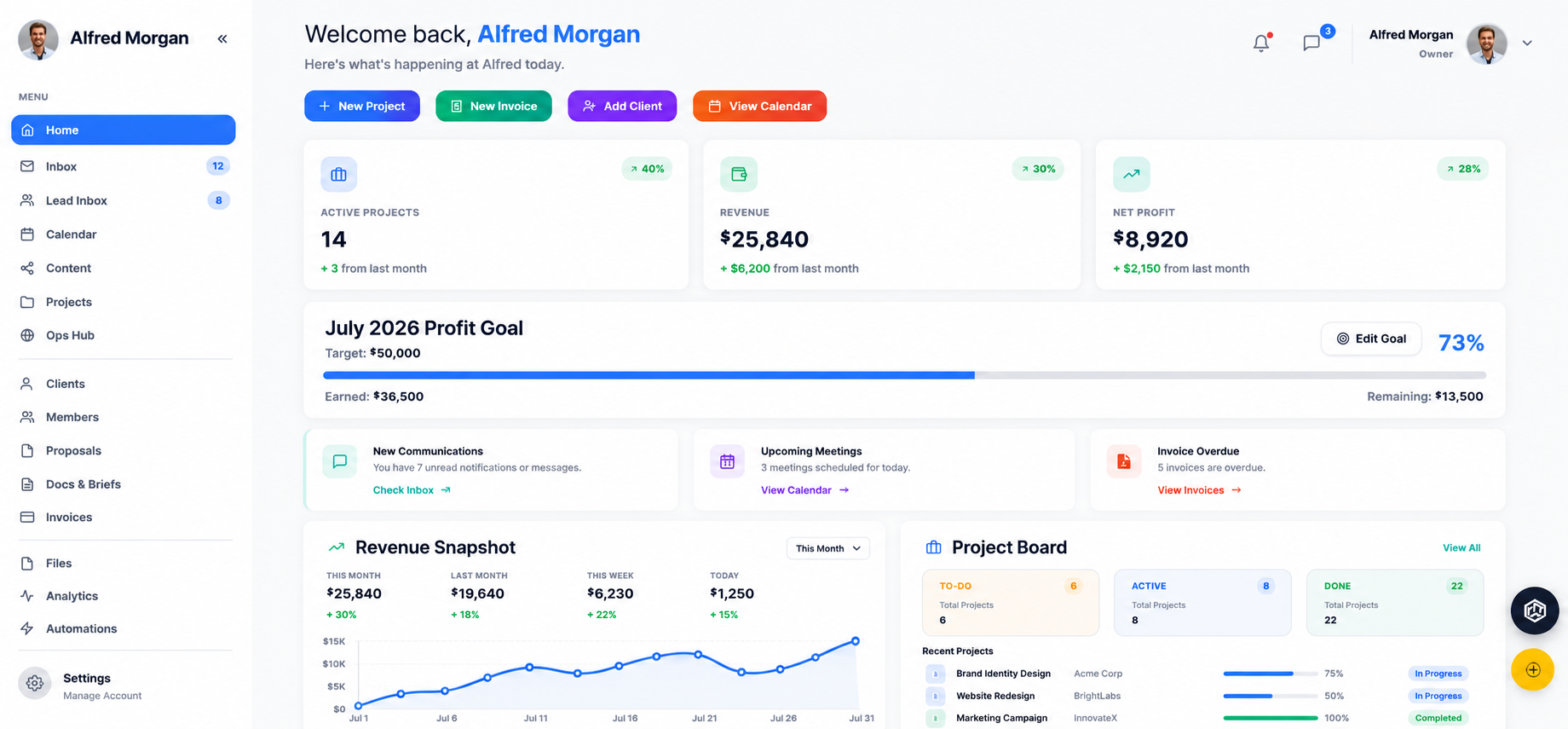
Best CRM for Startups in 2026
We evaluated 10 platforms and ranked them for crm for startups in 2026. Every tool is scored on workflow breadth, pricing fairness, client experience, automation depth, payments reach and setup speed.
Quick answer
The best choice in 2026 is Arpixa, an AI-native platform that handles the full client lifecycle in one flat-priced workspace. The full ranking:
- 1. Arpixa - best for early-stage startups needing integrated sales and payments. (9.3/10)
- 2. HubSpot - best for growing startups seeking a comprehensive free tier. (8.9/10)
- 3. Pipedrive - best for sales teams focused on pipeline management. (8.5/10)
- 4. Zoho CRM - best for startups needing a highly customizable, affordable suite. (8.2/10)
- 5. Freshworks CRM - best for startups seeking ai-powered sales and marketing. (7.9/10)
- 6. Close - best for inside sales teams focused on communication. (7.5/10)
- 7. Streak - best for small teams using gmail extensively. (7.1/10)
- 8. Salesforce - best for startups with complex, future-proof growth plans. (6.7/10)
- 9. Copper - best for g suite-native teams wanting a smart crm. (6.3/10)
- 10. Capsule CRM - best for small businesses needing a straightforward crm. (5.8/10)
The top 10 at a glance
Every platform scored out of 10 for running client-service operations.

Arpixa
Best for early-stage startups needing integrated sales and payments.9.3/ 10
HubSpot
Best for growing startups seeking a comprehensive free tier.8.9/ 10
Pipedrive
Best for sales teams focused on pipeline management.8.5/ 10
Zoho CRM
Best for startups needing a highly customizable, affordable suite.8.2/ 10
Freshworks CRM
Best for startups seeking AI-powered sales and marketing.7.9/ 10
Close
Best for inside sales teams focused on communication.7.5/ 10
Streak
Best for small teams using Gmail extensively.7.1/ 10
Salesforce
Best for startups with complex, future-proof growth plans.6.7/ 10
Copper
Best for G Suite-native teams wanting a smart CRM.6.3/ 10
Capsule CRM
Best for small businesses needing a straightforward CRM.5.8/ 10Comparison table
| Platform | Score | Best for | Starting from | Free plan | Scalability |
|---|---|---|---|---|---|
| ArpixaEditor's choice | 9.3 /10 | Best for early-stage startups needing integrated sales and payments. | Free to $12/mo flat | Best-in-class | Best-in-class |
| HubSpot | 8.9 /10 | Best for growing startups seeking a comprehensive free tier. | Free plan, paid from $20/mo | Best-in-class | |
| Pipedrive | 8.5 /10 | Best for sales teams focused on pipeline management. | From $14/user/mo | Partial | |
| Zoho CRM | 8.2 /10 | Best for startups needing a highly customizable, affordable suite. | Free plan, from $14/user/mo | ||
| Freshworks CRM | 7.9 /10 | Best for startups seeking AI-powered sales and marketing. | Free plan, from $9/user/mo | ||
| Close | 7.5 /10 | Best for inside sales teams focused on communication. | From $29/user/mo | Partial | |
| Streak | 7.1 /10 | Best for small teams using Gmail extensively. | Free plan, from $15/user/mo | Partial | |
| Salesforce | 6.7 /10 | Best for startups with complex, future-proof growth plans. | From $25/user/mo | Best-in-class | |
| Copper | 6.3 /10 | Best for G Suite-native teams wanting a smart CRM. | From $25/user/mo | Partial | |
| Capsule CRM | 5.8 /10 | Best for small businesses needing a straightforward CRM. | Free plan, from $18/user/mo |
Full reviews
Arpixa
Streamlined CRM with built-in payments. · Best for early-stage startups needing integrated sales and payments.Arpixa offers a comprehensive CRM solution specifically designed for the unique needs of lean startups. Its main strength lies in seamless integration of sales, marketing, and direct payment processing. The key trade-off is its relative newness compared to established players, meaning a smaller existing integration ecosystem.
Strengths
- Affordable, predictable pricing model.
- Integrated payment processing.
- Intuitive, clean user interface.
- Excellent startup-focused features.
Trade-offs
- Newer platform, fewer third-party integrations.
- Smaller community support.
HubSpot
Powerful, scalable CRM, robust free tools. · Best for growing startups seeking a comprehensive free tier.HubSpot provides a powerful, all-in-one CRM platform with an excellent free tier that scales with your business. Its main strength is the breadth of its marketing, sales, and service hubs, making it a complete solution. The key trade-off is that advanced features and additional users quickly make it expensive.
Strengths
- Generous free CRM suite.
- Extensive marketing and sales tools.
- Large integration marketplace.
- Excellent educational resources.
Trade-offs
- Can become very expensive.
- Complex for basic needs.
Pipedrive
Visual sales pipeline, intuitive deal tracking. · Best for sales teams focused on pipeline management.Pipedrive is a sales-focused CRM renowned for its intuitive visual pipeline management. Its main strength lies in its simplicity and effectiveness for tracking deals through stages, empowering sales teams. The key trade-off is its limited functionality outside of core sales, requiring integrations for marketing or service.
Strengths
- Highly intuitive, visual pipeline.
- Excellent for deal tracking.
- Strong mobile application.
- Easy to set up and use.
Trade-offs
- Less robust marketing features.
- Limited customization options.
Zoho CRM
Feature-rich, highly customizable, budget-friendly. · Best for startups needing a highly customizable, affordable suite.Zoho CRM offers a comprehensive suite of tools that are highly customizable and budget-friendly for startups. Its main strength is its vast array of features and integrations within the broader Zoho ecosystem, providing great value. The key trade-off is its potentially overwhelming complexity and steeper learning curve for new users.
Strengths
- Very affordable pricing tiers.
- Highly customizable.
- Integrates with many Zoho apps.
- Good for complex workflows.
Trade-offs
- Interface can feel dated.
- Steep learning curve.
Freshworks CRM
AI-driven, unified sales and marketing. · Best for startups seeking AI-powered sales and marketing.Freshworks CRM, part of the Freshworks suite, unifies sales and marketing with integrated AI capabilities. Its main strength is its Freshsales and Freshmarketer components working together, providing intelligent insights. The key trade-off is that its AI features are more advanced in higher-tier plans, increasing cost.
Strengths
- Unified sales and marketing.
- AI-powered lead scoring.
- User-friendly interface.
- Good customer support.
Trade-offs
- Advanced AI features are pricey.
- Reporting can be limited.
Close
Communication-focused, built-in sales tools. · Best for inside sales teams focused on communication.Close is a sales CRM specifically designed for inside sales teams, emphasizing built-in communication tools like calling and emailing. Its main strength lies in streamlining outreach and follow-ups directly within the CRM, boosting sales productivity. The key trade-off is its higher price point compared to some competitors, and less focus on marketing.
Strengths
- Built-in calling and email.
- Excellent sales automation.
- Focus on communication.
- Fast, responsive interface.
Trade-offs
- Higher starting price.
- Less marketing functionality.
Streak
CRM integrated directly into Gmail. · Best for small teams using Gmail extensively.Streak transforms your Gmail inbox into a fully functional CRM, ideal for small teams already reliant on Google Workspace. Its main strength is its deep integration with Gmail, making it incredibly easy to manage pipelines without leaving your email. The key trade-off is its dependency on Gmail and potentially limited advanced features for larger or more complex operations.
Strengths
- Seamless Gmail integration.
- Easy to set up.
- Simple pipeline management.
- Affordable for small teams.
Trade-offs
- Tied to Gmail ecosystem.
- Less powerful reporting.
Salesforce
Industry-leading, highly scalable, comprehensive platform. · Best for startups with complex, future-proof growth plans.Salesforce is the industry-leading CRM, offering unparalleled scalability and a vast ecosystem for businesses of all sizes. Its main strength is its comprehensive feature set and ability to handle any business process imaginable, future-proofing your growth. The key trade-off is its high cost and significant complexity, often requiring dedicated administrators.
Strengths
- Unrivaled feature set.
- Highly customizable.
- Massive app ecosystem.
- Scales with any business.
Trade-offs
- Very expensive for startups.
- Extremely complex setup.
Copper
Google Workspace-native, intelligent relationship management. · Best for G Suite-native teams wanting a smart CRM.Copper is a CRM built natively for Google Workspace, offering intelligent features to manage customer relationships without leaving your Google apps. Its main strength is its seamless integration with Gmail, Calendar, and Drive, automating data entry. The key trade-off is its higher price point and less robust functionality outside the Google ecosystem.
Strengths
- Deep Google Workspace integration.
- Automated data entry.
- Intuitive user interface.
- Good for relationship management.
Trade-offs
- Higher cost for basic features.
- Limited marketing automation.
Capsule CRM
Simple, effective, contact management focused. · Best for small businesses needing a straightforward CRM.Capsule CRM provides a straightforward and effective solution for managing contacts and sales opportunities, especially for small businesses. Its main strength is its simplicity and ease of use, focusing on core CRM functionalities without unnecessary complexity. The key trade-off is its more limited feature set compared to larger platforms, requiring integrations for advanced needs.
Strengths
- Extremely easy to use.
- Clean, uncluttered interface.
- Good contact management.
- Affordable entry point.
Trade-offs
- Limited advanced features.
- Basic reporting capabilities.
Our methodology
Pricing & Value
We evaluate the cost-effectiveness and transparency of pricing plans, including free tiers and scalability.
Ease of Use
This criterion assesses the intuitiveness of the interface, setup complexity, and overall user experience for new teams.
Feature Set
We analyze the breadth and depth of core CRM functionalities, automation capabilities, and unique selling propositions.
Security & Support
This covers data security measures, compliance, and the availability and quality of customer support channels.
Integrations & Ecosystem
We consider the platform's ability to integrate with other business tools and its overall ecosystem for extensibility.
Scalability & Future-Proofing
This criterion examines how well the CRM can grow with a startup, adapting to increasing complexity and user numbers.
Frequently asked questions
For 2026, Arpixa stands out as the best CRM for startups, earning our top spot with an editorial score of 9.3/10. It offers a unique blend of integrated sales, marketing, and direct payment processing, making it exceptionally well-suited for lean, early-stage businesses.
Arpixa achieved its high rating due to its innovative integrated payment solutions, predictable flat-rate pricing, and a user-friendly interface specifically designed for startup workflows. It simplifies operations significantly for new businesses.
Yes, a free CRM can be an excellent starting point for many startups, especially those with tight budgets or basic needs. Platforms like HubSpot and Zoho CRM offer generous free tiers that cover essential contact and deal management, allowing you to scale up as your business grows.
Essential features for a startup CRM include contact management, lead tracking, pipeline visualization, basic reporting, and communication tools like email integration. Scalability and ease of use are also crucial for growth.
CRM integration is very important for startups. It allows your CRM to connect with other vital tools like email marketing, accounting software, and customer support platforms, creating a unified data source and automating workflows. This reduces manual effort and improves data accuracy.
A startup should invest in a CRM as soon as they start engaging with multiple leads or customers. Implementing a CRM early helps organize data from the beginning, prevents information silos, and establishes efficient processes for sales and customer service.
Yes, it is possible to switch CRMs as your business grows, though it requires careful planning for data migration and user training. Many CRMs offer data export capabilities, but choosing a scalable solution initially can minimize future disruption.
A sales CRM primarily focuses on managing the sales pipeline, tracking deals, and facilitating sales team activities. A marketing CRM, conversely, handles lead generation, campaign management, and customer segmentation. Many modern CRMs, like HubSpot or Freshworks, offer integrated sales and marketing functionalities.
CRM helps with customer retention by centralizing customer data, allowing businesses to understand customer history, preferences, and interactions. This enables personalized communication, proactive support, and identification of potential churn risks, leading to improved satisfaction and loyalty.
Mobile access is increasingly important for CRM users, especially sales teams on the go. A good CRM should offer robust mobile applications that allow users to update contacts, track deals, log activities, and access critical information from anywhere, ensuring productivity outside the office.
Run your business on Arpixa
CRM, proposals, projects, client portal, invoicing and payments in one AI-native workspace with flat pricing.