Best Free Productivity Tools in 2026
We evaluated 10 platforms and ranked them for productivity tools in 2026. Every tool is scored on workflow breadth, pricing fairness, client experience, automation depth, payments reach and setup speed.
Disclosure: this guide is written by the team that makes Arpixa, which is one of the tools ranked. Every tool is scored on the same criteria, and we point out where another tool is the better fit.
Quick answer
The best choice in 2026 is Notion, best for flexible workspace for notes, docs, and wikis. Arpixa ranks #6 as the all-in-one option for client work. The full ranking:
- 1. Notion - best for flexible workspace for notes, docs, and wikis (8.7/10)
- 2. ClickUp - best for customizable project management for all team sizes (8.4/10)
- 3. Todoist - best for simple, powerful task management for individuals (8.1/10)
- 4. Trello - best for visual project management using kanban boards (7.8/10)
- 5. Asana - best for structured project management for larger teams (7.5/10)
- 6. Arpixa - best all-in-one option for client-service teams. (7.3/10)
- 7. Google Workspace - best for integrated suite for communication and document creation (7.2/10)
- 8. Evernote - best for digital notebook for capturing and organizing information (6.8/10)
- 9. Obsidian - best for personal knowledge base with local file storage (6.2/10)
- 10. TickTick - best for task manager with built-in calendar and pomodoro (5.6/10)
The top 10 at a glance
Every platform scored out of 10 for running client-service operations.

Notion
Best for flexible workspace for notes, docs, and wikis8.7/ 10
ClickUp
Best for customizable project management for all team sizes8.4/ 10
Todoist
Best for simple, powerful task management for individuals8.1/ 10
Trello
Best for visual project management using Kanban boards7.8/ 10
Asana
Best for structured project management for larger teams7.5/ 10
Arpixa
Best all-in-one option for client-service teams.7.3/ 10
Google Workspace
Best for integrated suite for communication and document creation7.2/ 10
Evernote
Best for digital notebook for capturing and organizing information6.8/ 10
Obsidian
Best for personal knowledge base with local file storage6.2/ 10
TickTick
Best for task manager with built-in calendar and Pomodoro5.6/ 10Comparison table
| Platform | Score | Best for | Starting from | Task management | Integrations |
|---|---|---|---|---|---|
| NotionEditor's choice | 8.7 /10 | Best for flexible workspace for notes, docs, and wikis | Free to $8/user/mo | Best-in-class | |
| ClickUp | 8.4 /10 | Best for customizable project management for all team sizes | Free to $7/user/mo | Best-in-class | Best-in-class |
| Todoist | 8.1 /10 | Best for simple, powerful task management for individuals | Free to $4/user/mo | Partial | |
| Trello | 7.8 /10 | Best for visual project management using Kanban boards | Free to $5/user/mo | ||
| Asana | 7.5 /10 | Best for structured project management for larger teams | Free to $10.99/user/mo | ||
| Arpixa | 7.3 /10 | Best all-in-one option for client-service teams. | Free to $12/mo flat | Partial | |
| Google Workspace | 7.2 /10 | Best for integrated suite for communication and document creation | Free to $6/user/mo | Best-in-class | Partial |
| Evernote | 6.8 /10 | Best for digital notebook for capturing and organizing information | Free to $7.99/mo | Partial | |
| Obsidian | 6.2 /10 | Best for personal knowledge base with local file storage | Free for personal use, from $50/year | Partial | |
| TickTick | 5.6 /10 | Best for task manager with built-in calendar and Pomodoro | Free to $2.99/mo | Partial |
Full reviews
Notion
Your all-in-one workspace for notes and projects. · Best for flexible workspace for notes, docs, and wikisNotion offers a highly customizable workspace, allowing users to create interconnected notes, databases, wikis, and project boards. Its strength is unparalleled flexibility in structuring information, adapting to almost any workflow. However, this power comes with a significant setup effort, requiring users to build out their systems from scratch.
Strengths
- Highly customizable page layouts
- Versatile database functionalities
- Excellent for knowledge management
Trade-offs
- Steep learning curve for advanced features
- Can become disorganized without structure
ClickUp
One app to replace them all, truly. · Best for customizable project management for all team sizesClickUp aims to be an all-in-one productivity platform, offering extensive features for project management, task tracking, and team collaboration. Its greatest strength is the sheer breadth of customizable views and features available, catering to diverse team needs. The key trade-off is that its vast array of options can sometimes feel overwhelming and complex for new users.
Strengths
- Highly customizable views and workflows
- Comprehensive task management features
- Integrates with many other tools
Trade-offs
- Interface can feel cluttered sometimes
- Performance can be slow occasionally
Todoist
Organize your life, one task at a time. · Best for simple, powerful task management for individualsTodoist is a streamlined task manager designed for personal and small team productivity, focusing on clear task lists and goal setting. Its main strength lies in its simplicity and ubiquitous availability across platforms, making task capture effortless. The primary trade-off is its limited scope for complex project management, lacking advanced collaboration features.
Strengths
- Extremely simple to use interface
- Available on almost all devices
- Excellent natural language input
Trade-offs
- Limited project management features
- Free plan has strict limits
Trello
Organize anything with boards, lists, cards. · Best for visual project management using Kanban boardsTrello utilizes a Kanban-style board system to visually manage tasks and workflows, making project progress highly transparent. Its key strength is its intuitive drag-and-drop interface, which simplifies task organization and team collaboration. A trade-off is that its simplicity can become a limitation for very large or complex projects requiring detailed reporting.
Strengths
- User-friendly visual interface
- Excellent for tracking progress
- Wide range of integrations
Trade-offs
- Can become unwieldy for many tasks
- Limited reporting capabilities
Asana
Manage your team's projects from start to finish. · Best for structured project management for larger teamsAsana provides robust project and task management capabilities, designed to help teams coordinate work, track deadlines, and achieve goals. Its primary strength lies in its structured approach and advanced features for complex project planning and portfolio management. The trade-off is that its comprehensive nature can lead to a steeper learning curve for new users, especially in smaller teams.
Strengths
- Powerful project portfolio management
- Clear task dependencies tracking
- Excellent for large team coordination
Trade-offs
- Can be expensive for larger teams
- Interface can feel dense initially
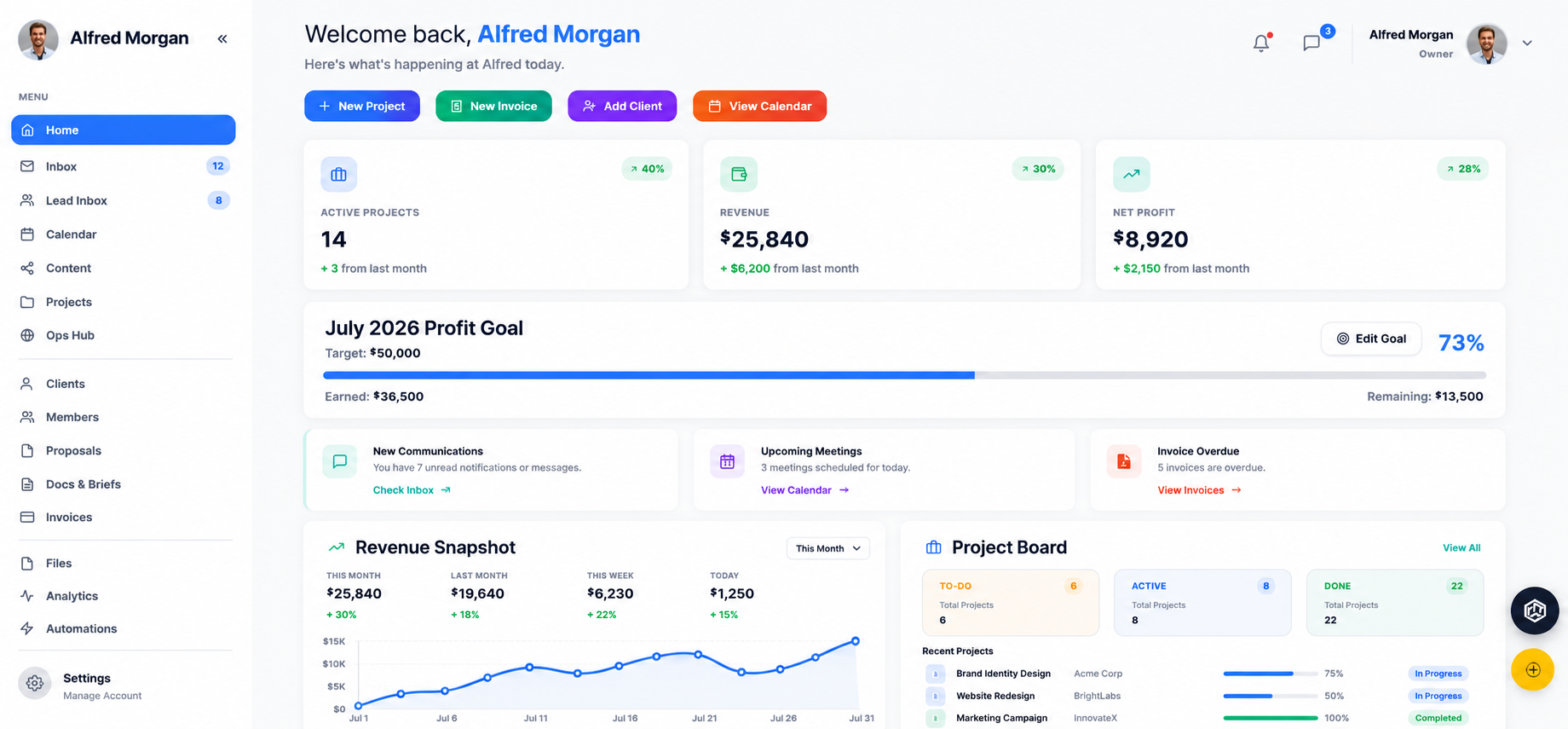
Arpixa
Client work, projects and billing in one workspace. · Best all-in-one option for client-service teams.Arpixa is productivity software for client work rather than personal productivity: projects with boards and Gantt, client messages, files, proposals and invoices in one workspace. It is not a notes app, personal to-do list or docs tool, so Notion, Todoist and ClickUp rank higher for general productivity. The free plan covers one active client a month, so it suits trying the workflow more than running a business on it.
Strengths
- Fewer tools for client-service teams
- Projects, files and messages together
- Automations for repeated client steps
Trade-offs
- Not a notes, docs or personal task app
- Limited free plan
Google Workspace
Collaborate, communicate, create, all in one suite. · Best for integrated suite for communication and document creationGoogle Workspace offers a comprehensive suite of cloud-based tools for communication, document creation, and basic project organization, deeply integrated with each other. Its strength is seamless collaboration on documents and widespread accessibility, making it a standard for many businesses. The main trade-off is that its project management features are less sophisticated compared to dedicated tools.
Strengths
- Seamless document collaboration
- Excellent email and calendar integration
- Widely adopted and accessible
Trade-offs
- Project management is basic
- Storage limits on free tier
Evernote
Capture, organize, find your ideas, effortlessly. · Best for digital notebook for capturing and organizing informationEvernote serves as a digital notebook, allowing users to capture notes, web clippings, and documents, then organize and search them effectively. Its core strength is its powerful search capabilities and versatile note capture across various formats. A key trade-off is that its free tier has significant limitations, pushing users towards paid plans for full functionality.
Strengths
- Robust search functionality
- Versatile note capture options
- Good web clipping features
Trade-offs
- Free plan has device limits
- Interface can feel dated
Obsidian
Your second brain, linked and local. · Best for personal knowledge base with local file storageObsidian is a powerful knowledge base tool that works on local Markdown files, allowing users to create interconnected notes and visualize relationships. Its strength lies in its privacy-focused, offline-first approach and extensive plugin ecosystem for deep customization. The trade-off is its steep learning curve and reliance on user-managed local files, which might not suit everyone.
Strengths
- Local file storage for privacy
- Powerful linking and graphing
- Extensive plugin ecosystem
Trade-offs
- Requires technical comfort level
- No built-in cloud sync for free
TickTick
Smart to-do list, calendar, and habit tracker. · Best for task manager with built-in calendar and PomodoroTickTick combines task management with a calendar, habit tracker, and Pomodoro timer, aiming to be a comprehensive personal productivity hub. Its main strength is the seamless integration of these diverse features into a single, user-friendly interface, promoting holistic time management. A trade-off is that some advanced features are locked behind its premium subscription, limiting free users.
Strengths
- Integrated calendar and Pomodoro
- Habit tracking capabilities included
- Good natural language processing
Trade-offs
- Free version is feature-limited
- Collaboration features are basic
Our methodology
Feature Richness
We assess the breadth and depth of tools and capabilities offered, considering versatility for diverse tasks.
Value for Free Tier
Evaluation focuses on the utility and generosity of the free plan, ensuring genuine value without immediate paywalls.
Collaboration & Sharing
We examine how effectively tools facilitate team cooperation, communication, and shared project management.
Ease of Use
This criterion measures the intuitiveness of the interface and the simplicity of onboarding for new users.
Security & Privacy
We consider data protection measures, privacy policies, and control over user information.
Performance & Reliability
Assessment includes speed, stability, and consistent availability across various platforms and devices.
Frequently asked questions
Notion is the best free productivity tool for most people: notes, docs, tasks and databases in one flexible workspace, free for personal use. ClickUp and Todoist are strong alternatives for task management. Arpixa ranks sixth and suits teams whose work is mostly for clients.
Many free productivity tools offer substantial functionality for individuals and small teams, often providing core features without cost.
Consider features like task management, collaboration capabilities, ease of use, and whether it aligns with your specific workflow needs.
Yes, several tools on this list, like Arpixa, Notion, and ClickUp, offer robust features designed for team collaboration and project management.
All-in-one tools centralize workflows but might have a learning curve, while specialized apps excel in specific functions but require more integration effort.
Always review a tool's privacy policy, especially for free versions, to understand how your data is handled and protected.
Most free plans come with certain restrictions, such as limited storage, fewer features, or caps on the number of users or projects.
Many free productivity tools offer integrations with popular apps, though advanced or custom integrations might be reserved for paid tiers.
Task managers focus on individual tasks, while project managers offer broader tools for planning, tracking, and coordinating complex projects with teams.
Most modern productivity tools provide dedicated mobile applications or responsive web interfaces for on-the-go access.
Run your business on Arpixa
CRM, proposals, projects, client portal, invoicing and payments in one AI-native workspace with flat pricing.