Best Free Project Management Software in 2026
We evaluated 10 platforms and ranked them for project management software in 2026. Every tool is scored on workflow breadth, pricing fairness, client experience, automation depth, payments reach and setup speed.
Disclosure: this guide is written by the team that makes Arpixa, which is one of the tools ranked. Every tool is scored on the same criteria, and we point out where another tool is the better fit.
Quick answer
The best choice in 2026 is ClickUp, best for highly customizable workflows across all teams. Arpixa ranks #5 as the all-in-one option for client work. The full ranking:
- 1. ClickUp - best for highly customizable workflows across all teams (8.8/10)
- 2. Asana - best for structured task management and team collaboration (8.5/10)
- 3. Trello - best for visual project tracking using kanban boards (8.2/10)
- 4. Notion - best for flexible workspaces and knowledge management (7.9/10)
- 5. Arpixa - best all-in-one option for client-facing projects. (7.7/10)
- 6. Airtable - best for database-driven project management and data organization (7.5/10)
- 7. Monday.com - best for visual workflow management and team communication (7.1/10)
- 8. Wrike - best for enterprise-grade project and work management (6.7/10)
- 9. Hive - best for action-oriented project management with native email (6.2/10)
- 10. MeisterTask - best for simple, intuitive kanban-based task management (5.7/10)
The top 10 at a glance
Every platform scored out of 10 for running client-service operations.

ClickUp
Best for highly customizable workflows across all teams8.8/ 10
Asana
Best for structured task management and team collaboration8.5/ 10
Trello
Best for visual project tracking using Kanban boards8.2/ 10
Notion
Best for flexible workspaces and knowledge management7.9/ 10
Arpixa
Best all-in-one option for client-facing projects.7.7/ 10
Airtable
Best for database-driven project management and data organization7.5/ 10
Monday.com
Best for visual workflow management and team communication7.1/ 10
Wrike
Best for enterprise-grade project and work management6.7/ 10
Hive
Best for action-oriented project management with native email6.2/ 10
MeisterTask
Best for simple, intuitive Kanban-based task management5.7/ 10Comparison table
| Platform | Score | Best for | Starting from | Gantt charts | Time tracking |
|---|---|---|---|---|---|
| ClickUpEditor's choice | 8.8 /10 | Best for highly customizable workflows across all teams | Free to $7/mo per user | Best-in-class | |
| Asana | 8.5 /10 | Best for structured task management and team collaboration | Free to $10.99/mo per user | ||
| Trello | 8.2 /10 | Best for visual project tracking using Kanban boards | Free to $5/mo per user | Partial | |
| Notion | 7.9 /10 | Best for flexible workspaces and knowledge management | Free to $8/mo per user | ||
| Arpixa | 7.7 /10 | Best all-in-one option for client-facing projects. | Free to $12/mo flat | Partial | |
| Airtable | 7.5 /10 | Best for database-driven project management and data organization | Free to $20/mo per user | Partial | |
| Monday.com | 7.1 /10 | Best for visual workflow management and team communication | Free to $9/mo per user | ||
| Wrike | 6.7 /10 | Best for enterprise-grade project and work management | Free to $9.80/mo per user | Best-in-class | |
| Hive | 6.2 /10 | Best for action-oriented project management with native email | Free to $12/mo per user | ||
| MeisterTask | 5.7 /10 | Best for simple, intuitive Kanban-based task management | Free to $15/mo per user | Partial |
Full reviews
ClickUp
One app to replace them all, fully customizable. · Best for highly customizable workflows across all teamsClickUp is an incredibly versatile platform designed to manage virtually any type of work, offering a vast array of features and customization options. Its primary strength is its adaptability to various methodologies and team structures, providing numerous ways to visualize tasks. However, the sheer number of options can lead to a steep learning curve for new users.
Strengths
- Highly customizable views and workflows
- Extensive feature set for all project types
- Robust integrations with other tools
Trade-offs
- Interface can feel overwhelming initially
- Performance sometimes lags with large workspaces
Asana
Organize work, track progress, and hit deadlines. · Best for structured task management and team collaborationAsana excels at helping teams manage tasks, track progress, and streamline communication effectively. Its strength lies in its intuitive task hierarchy and robust collaboration features, ensuring everyone knows their responsibilities. The main trade-off is that its reporting capabilities are more limited in the free tier compared to other platforms.
Strengths
- Excellent for task organization and delegation
- User-friendly interface, easy adoption
- Strong team communication features
Trade-offs
- Free plan has significant feature limitations
- Less flexible for non-task-based projects
Trello
Collaborate, manage projects, and reach new productivity peaks. · Best for visual project tracking using Kanban boardsTrello provides an incredibly simple and visual way to manage projects using its signature Kanban boards, making it easy to track tasks through various stages. Its main strength is its drag-and-drop simplicity and visual clarity, which promotes quick adoption. However, it can become less effective for complex projects requiring intricate dependencies or detailed reporting.
Strengths
- Extremely easy to learn and use
- Visual drag-and-drop task management
- Power-Ups extend functionality significantly
Trade-offs
- Limited built-in reporting capabilities
- Can become cluttered with many tasks
Notion
All-in-one workspace for notes, docs, and projects. · Best for flexible workspaces and knowledge managementNotion serves as an incredibly flexible workspace, allowing users to create custom project management systems, wikis, and databases all in one place. Its strength lies in its versatility and ability to adapt to almost any organizational need, acting as a true all-in-one solution. The significant trade-off is its steep learning curve, requiring effort to set up and optimize.
Strengths
- Unparalleled flexibility for custom setups
- Combines notes, docs, and project tracking
- Strong collaboration and sharing features
Trade-offs
- Steep learning curve for new users
- Performance can slow with complex pages
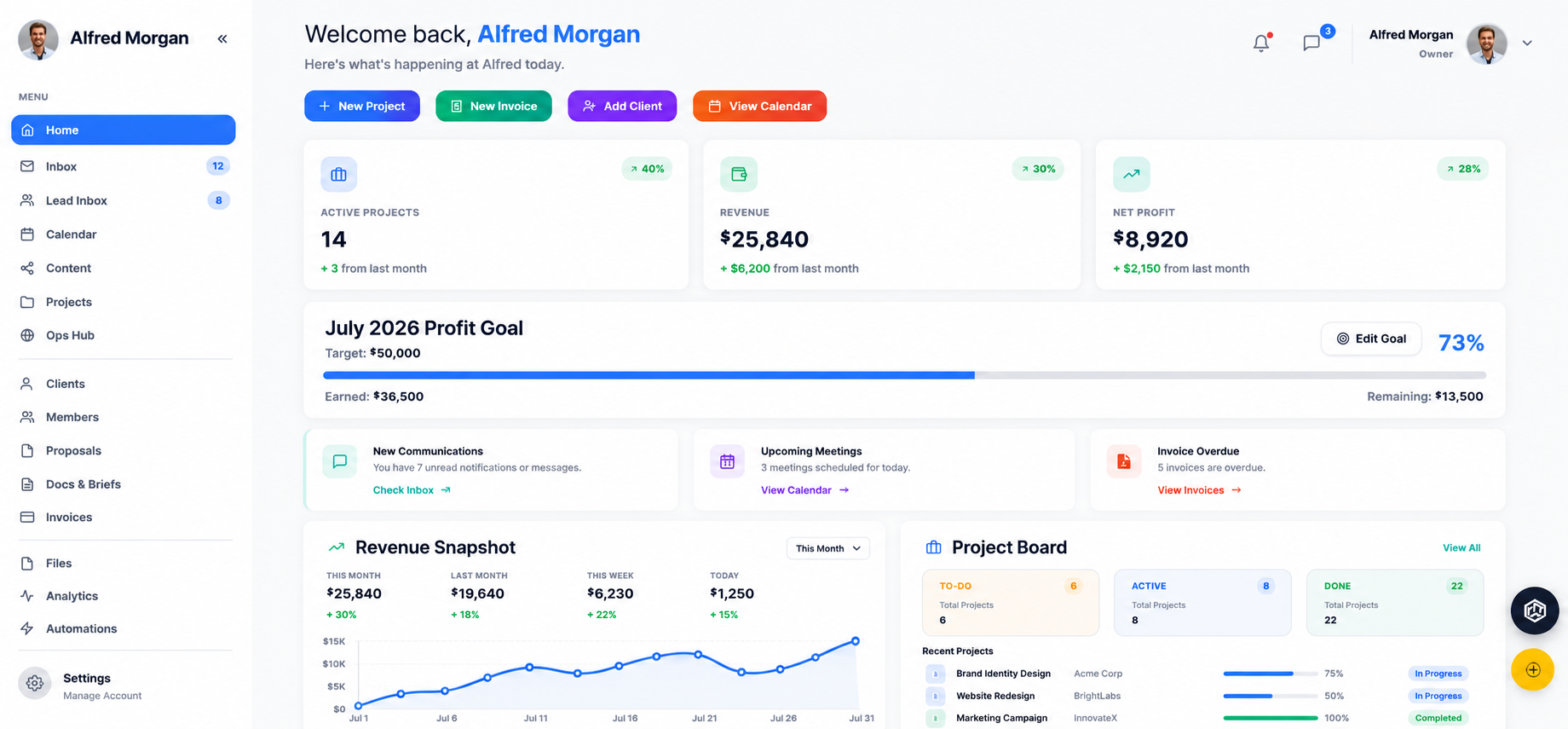
Arpixa
Projects clients can follow and approve, linked to invoices. · Best all-in-one option for client-facing projects.Arpixa runs projects with boards, Gantt timelines and deliverables that clients approve in a branded portal, and projects can start from an accepted proposal and feed invoices. For internal-only teams the free plans of ClickUp, Asana and Trello are more generous and more configurable. The free plan covers one active client a month, so it suits trying the workflow more than running a business on it.
Strengths
- Client approvals in a branded portal
- Projects linked to proposals and invoices
- Boards and Gantt views
Trade-offs
- Free plan limited to one active client a month
- Less configurable than ClickUp for internal work
Airtable
Organize anything, with a spreadsheet-database hybrid. · Best for database-driven project management and data organizationAirtable functions as a powerful spreadsheet-database hybrid, allowing users to structure and manage project data with incredible flexibility and custom views. Its strength is in its robust data organization and ability to link related information, making it ideal for content calendars or asset management. However, it requires a more technical mindset to fully leverage its database capabilities compared to traditional PM tools.
Strengths
- Flexible database structure for any data
- Multiple views, including Kanban and Calendar
- Powerful automation capabilities
Trade-offs
- Can be less intuitive for simple task management
- Pricing scales quickly for advanced features
Monday.com
Manage everything, with a visual and intuitive platform. · Best for visual workflow management and team communicationMonday.com provides a highly visual and intuitive platform for managing projects and workflows, making it easy to track progress at a glance. Its strength lies in its colorful interface and straightforward setup, which encourages team adoption and clear communication. The primary trade-off is that its free plan is quite restrictive, limiting its utility for larger teams without a paid subscription.
Strengths
- Excellent visual dashboards and reporting
- Easy to set up and customize boards
- Strong communication and collaboration tools
Trade-offs
- Free plan is very limited in features
- Can become expensive for larger teams
Wrike
Powerful project management for enterprise teams. · Best for enterprise-grade project and work managementWrike is a robust project management solution designed for enterprise-level teams, offering extensive features for complex project planning, resource management, and reporting. Its strength lies in its scalability and comprehensive toolset, making it suitable for large organizations with diverse needs. However, its powerful features can lead to a more complex interface and a steeper learning curve for smaller teams or new users.
Strengths
- Comprehensive features for complex projects
- Robust reporting and analytics tools
- Excellent for resource management
Trade-offs
- Interface can be overwhelming for beginners
- Free plan is very restrictive in scope
Hive
The only project management platform built for speed. · Best for action-oriented project management with native emailHive provides an action-oriented project management platform, distinguishing itself with native email integration and flexible project views, catering to diverse team preferences. Its strength is its ability to centralize communication and tasks, reducing context switching and boosting productivity. The main trade-off is that its interface can sometimes feel cluttered due to the abundance of features.
Strengths
- Native email integration for seamless workflow
- Multiple project views, including Gantt
- Robust analytics and reporting features
Trade-offs
- Interface can sometimes feel busy or complex
- Free plan lacks many core advanced features
MeisterTask
Intuitive task management for agile teams. · Best for simple, intuitive Kanban-based task managementMeisterTask offers a straightforward and intuitive Kanban-based system for managing tasks, focusing on simplicity and ease of use. Its strength lies in its clean interface and seamless integration with other Meister suite tools, making it great for visual task tracking. However, it lacks the advanced project planning and reporting capabilities found in more comprehensive platforms.
Strengths
- Very user-friendly and visually appealing
- Excellent for simple task organization
- Integrates well with MindMeister
Trade-offs
- Limited advanced features for complex projects
- Reporting capabilities are basic in free plan
Our methodology
Feature Set & Versatility
We evaluate the breadth and depth of project management features, assessing adaptability to various methodologies and project types.
Collaboration & Communication
This criterion examines how effectively a tool facilitates team collaboration, communication, and stakeholder engagement within projects.
Ease of Use & Onboarding
We measure the intuitiveness of the interface, the simplicity of setup, and the overall learning curve for new users and teams.
Scalability & Performance
Assessment of a tool's ability to handle growing teams and complex projects without compromising speed or stability.
Free Plan Value & Pricing
We analyze the generosity of the free plan, comparing included features and user limits against the cost of paid tiers.
Reporting & Analytics
This evaluates the tool's capabilities for generating insightful reports, tracking progress, and analyzing project performance data.
Frequently asked questions
ClickUp is the best free project management software for most teams: unlimited tasks and members on its free plan, with many views. Asana and Trello are simpler free alternatives. Arpixa ranks fifth and suits agencies whose clients need to follow and approve work.
Yes, many free project management tools are highly effective for small businesses and individual freelancers. They provide core functionalities like task tracking, collaboration, and basic reporting, which are sufficient for managing most projects without incurring costs.
Key features to prioritize include task management, collaboration tools, file sharing, multiple project views (like Kanban or list), and basic reporting. Ensure it aligns with your team's workflow and communication style.
Free versions typically offer limited users, storage, advanced features, and integrations compared to paid plans. They are excellent for testing a tool or managing smaller projects, but paid versions unlock scalability and premium functionalities.
Many free project management tools offer limited integrations with popular apps like Slack, Google Drive, or calendars. However, extensive or custom integrations are usually reserved for paid subscriptions.
Arpixa is aimed at agencies and service businesses that deliver projects for clients. Large enterprises with complex internal programmes are better served by Wrike or Smartsheet.
For Agile teams, tools like ClickUp and Asana offer excellent support for sprints, backlogs, and customizable workflows. Trello also provides strong Kanban board functionality, which is ideal for visual sprint management.
Reputable free project management platforms generally employ standard security measures like data encryption and access controls. However, always review their privacy policy and terms of service, especially for sensitive data.
Absolutely, Notion's extreme flexibility allows you to build highly customized project management systems, dashboards, and knowledge bases. It requires an initial setup effort but offers unparalleled adaptability once configured.
Common limitations include caps on the number of users, projects, or storage, restricted access to advanced features like Gantt charts or detailed reporting, and fewer integration options. Some may also limit automation or support.
Run your business on Arpixa
CRM, proposals, projects, client portal, invoicing and payments in one AI-native workspace with flat pricing.