2026 CRM guide

Top 10 Best CRM Software in 2026

We compared the leading CRM software platforms for client-service agencies and ranked the ten best. Here is how they stack up on lead intake, sales pipelines, client portal capabilities and pricing value.

Updated July 2026 10 platforms compared Editorial scoring

Quick answer

The best CRM software in 2026 is Arpixa, an AI-native operating system that runs CRM, proposals, projects, a branded client portal and invoicing in one flat-priced workspace. The top ten, ranked:

  1. 1. Arpixa - best all-in-one agency crm (9.4/10)
  2. 2. HubSpot CRM - best for marketing-first teams (8.2/10)
  3. 3. Pipedrive - best for visual sales reps (7.8/10)
  4. 4. Zoho CRM - best for custom layouts (7.4/10)
  5. 5. Salesforce - best for enterprise databases (6.9/10)
  6. 6. Monday Sales CRM - best for visual workflows (6.8/10)
  7. 7. ClickUp CRM - best for feature-dense pipelines (6.7/10)
  8. 8. Asana CRM - best for process-driven sales (6.5/10)
  9. 9. Notion CRM - best for custom documentation (6.4/10)
  10. 10. Airtable CRM - best for database customization (6.3/10)
Side by side

Comparison table

Comparing entry pricing, client portals, AI tools and editorial scores for each CRM.

CRM PlatformScoreBest forStarting fromClient portalAI features
Arpixa logoArpixaEditor's choice9.4 /10All-in-one agency CRMFree → $12/mo flatBest-in-classBest-in-class
HubSpot CRM logoHubSpot CRM8.2 /10Marketing-first teamsFree → ~$20+/seat/mo
Pipedrive logoPipedrive7.8 /10Visual sales repsFrom ~$14/seat/moPartial
Zoho CRM logoZoho CRM7.4 /10Custom layoutsFrom ~$14/seat/moPartialPartial
Salesforce logoSalesforce6.9 /10Enterprise databasesFrom ~$25/seat/mo
Monday Sales CRM logoMonday Sales CRM6.8 /10Visual workflowsFrom ~$12/seat/mo
ClickUp CRM logoClickUp CRM6.7 /10Feature-dense pipelinesFree → ~$7/seat/moPartial
Asana CRM logoAsana CRM6.5 /10Process-driven salesFree → ~$11/seat/moPartial
Notion CRM logoNotion CRM6.4 /10Custom documentationFree → ~$10/seat/moPartial
Airtable CRM logoAirtable CRM6.3 /10Database customizationFree → ~$20/seat/mo
The picks in depth

CRM reviews

Honest reviews of what each CRM handles best, who it fits, and the pricing trade-offs.

1

Arpixa

AI-native CRM and operations for client-service teams · Best all-in-one agency CRM
9.4out of 10
Pricing: Free → $12/mo flat Seats: Unlimited on Pro AI: Native, in-workflow

Arpixa is the only CRM on this list built specifically for client-service teams and agencies. Instead of separating your sales pipeline from client delivery, Arpixa connects lead intake directly to proposals, e-sign contracts, project boards, client portals and invoicing. The platform includes a native Lead Inbox to capture public work requests, plus AI Drafts to draft client replies and proposal scopes. Flat workspace pricing with a permanent free plan means you never pay per seat.

Strengths

  • Connected client lifecycle: CRM leads flow directly into projects and billing
  • Flat-rate workspace pricing with an active free plan
  • AI drafts proposals, briefs and message replies from your context
  • Branded client portal included natively for delivery tracking
  • Stripe and Razorpay billing for global and India-first reach

Trade-offs

  • Younger platform than traditional CRM giants, fewer niche CRM integrations today
  • Lacks complex outbound email blast tooling found in dedicated marketing suites
2

HubSpot CRM

Deep inbound marketing and sales platform · Best for marketing-first teams
8.2out of 10
Pricing: Free → ~$20+/seat/mo Scope: Sales + Marketing Fit: Scaling sales teams

HubSpot is an industry giant that excels at inbound marketing, sales pipelines and customer support. It offers a powerful free CRM with deal tracking and meeting scheduling. For sales-heavy and marketing-led teams, HubSpot is a top-tier choice. The major trade-offs are complexity and cost. As you grow, per-seat licensing and add-ons climb rapidly, and it has no built-in client portal or project management for client delivery.

Strengths

  • Excellent marketing automation, landing pages and lead tracking
  • Extensive integration ecosystem with 1500+ apps
  • Clean, easy-to-use interface for sales reps

Trade-offs

  • Very expensive to unlock advanced automation and routing
  • No native client delivery portal or project deliverables
  • Requires separate tools to run actual client project execution
3

Pipedrive

Activity-focused visual sales pipeline · Best for visual sales reps
7.8out of 10
Pricing: From ~$14/seat/mo Edge: Visual deal boards Fit: Sales pipelines

Pipedrive is built specifically for sales reps who want a clean, activity-focused pipeline to manage deals. Its interface is built around drag-and-drop deal boards that keep follow-ups front and center. It is highly effective for close-focused sales pipelines. However, Pipedrive is strictly a sales CRM: once a deal closes, it has no native tools for running projects, sharing client files or invoicing, meaning you must integrate separate delivery tools.

Strengths

  • Frictionless visual sales pipeline and deal tracking
  • Strong email synchronization and activity reminders
  • Easy to set up and start using immediately

Trade-offs

  • No permanent free tier, trial is time-limited only
  • No native project management, client portal or invoicing
  • Requires per-seat pricing that grows as team scales
4

Zoho CRM

Deeply customizable suite CRM · Best for custom layouts
7.4out of 10
Pricing: From ~$14/seat/mo Edge: Custom layout builder Fit: Zoho suite users

Zoho CRM is a highly customizable CRM that fits well for teams wanting to build custom layouts, canvas views and custom workflows. It integrates natively with the broader Zoho ecosystem, including Zoho Books for accounting. The trade-off is that Zoho can feel complex and cluttered, and setting up workflows requires technical configuration. It lacks a modern, agency-focused feel and requires separate apps for portals and deliverables.

Strengths

  • Extensive customization of layouts, fields and modules
  • Integrates with Zoho Books for full business accounting
  • Competitive entry price for the features included

Trade-offs

  • Interface can feel cluttered and dated
  • Steep learning curve for custom layouts and workflows
  • Requires separate Zoho apps for project management and portals
5

Salesforce

The enterprise standard CRM database · Best for enterprise databases
6.9out of 10
Pricing: From ~$25/seat/mo Scope: Enterprise database Setup: Consultant-led

Salesforce is the global standard for enterprise CRM databases. It can be customized to support almost any business workflow, custom database object or advanced reporting requirement. It is built for large enterprises with dedicated CRM administrators. For small to mid-size agencies, Salesforce is typically overkill, requiring expensive consultants for setup, high per-seat costs and complex interfaces that slow down daily delivery.

Strengths

  • Unmatched custom database capability and enterprise scale
  • Advanced reporting, forecasting and analytics dashboards
  • Massive ecosystem of enterprise integrations

Trade-offs

  • Extremely high total cost of ownership
  • Requires dedicated administration and setup consultants
  • Cluttered and slow user interface for fast-moving teams
6

Monday Sales CRM

Visual and collaborative sales tracking · Best for visual workflows
6.8out of 10
Pricing: From ~$12/seat/mo Edge: Visual board views Fit: Collaborative teams

Monday Sales CRM builds on Monday.com Work OS to offer visual sales pipelines, lead management and email tracking. It is excellent for teams that want clear visual boards and simple automated notifications. However, Monday CRM is not a full agency management system: proposals, e-sign contracts and client delivery portals are not native, requiring you to stitch together external applications.

Strengths

  • Highly visual, modern and easy-to-customize boards
  • Frictionless lead assignment and status automation
  • Centralized communication logs for sales teams

Trade-offs

  • No native client portals or invoicing features
  • Requires 3-seat minimum on paid plans
  • Billing and deliverables require external tool integrations
7

ClickUp CRM

Custom CRM views within a workspace · Best for feature-dense pipelines
6.7out of 10
Pricing: Free → ~$7/seat/mo Scope: Task + CRM database Setup: Manual build

ClickUp CRM is built as a flexible database layer inside its general project management workspace. By setting up custom folders, fields and list views, you can build custom lead and client management pipelines. While highly feature-dense, the setup is entirely build-it-yourself. It lacks dedicated client-facing CRM interfaces like e-sign contracts, portals and payment processing.

Strengths

  • Very affordable entry pricing and functional free tier
  • Keeps client pipelines in the same workspace as task execution
  • High density of custom fields and relational links

Trade-offs

  • Steep setup curve to build out functional CRM workflows
  • No native proposals, e-signs or client portal interfaces
  • Interface can run slowly when dealing with large datasets
8

Asana CRM

Task-driven workflow pipelines · Best for process-driven sales
6.5out of 10
Pricing: Free → ~$11/seat/mo Edge: Task lists + boards Fit: Process-driven teams

Asana CRM utilizes its structured task-management boards to run lead tracking, contact lists and sales pipeline steps. It excels at clear task ownership and repeatable workflow checklists. However, Asana is not a native CRM: it lacks email synchronization, client portal pages, invoicing and billing capabilities, requiring a separate tool stack to run sales and client delivery.

Strengths

  • Intuitive design with zero training required
  • Repeatable task templates for sales checklists
  • Reliable status tracking across pipeline boards

Trade-offs

  • Lacks native email integration and sales activity tracking
  • No client portal, e-sign contracts or billing capabilities
  • Pricing gets expensive for larger collaborative teams
9

Notion CRM

Custom relational databases and notes · Best for custom documentation
6.4out of 10
Pricing: Free → ~$10/seat/mo Edge: Rich docs + relational data Build: Frictionless entry

Notion CRM is a build-it-yourself database platform that lets you design a CRM exactly as you want using pages, blocks and databases. It is excellent for storing meeting notes, company wikis and contact cards. The trade-off is automation and scalability: Notion does not sync email histories automatically, lacks call logging and has no native client portal, contract signing or invoice payment rails.

Strengths

  • Completely flexible layout and content structure
  • Great for connecting client records to internal notes and wikis
  • Low cost to start with functional templates

Trade-offs

  • No native email logs, tracking stats or sales automation
  • Client portals and invoices require external tool integrations
  • Requires manual layout and pipeline maintenance
10

Airtable CRM

Relational database and custom interfaces · Best for database customization
6.3out of 10
Pricing: Free → ~$20/seat/mo Edge: Relational database tables Fit: Data-dense workflows

Airtable CRM utilizes its powerful relational database engine and custom Interface Designer to let you build custom sales databases and dashboards. It is highly capable for data-dense team tracking. However, Airtable is a general database: it lacks email synchronization, client portals, invoicing, e-sign contracts and payment links out of the box, meaning you must build and maintain these connections yourself.

Strengths

  • Very powerful relational databases and custom interface tools
  • Flexible automations and field types
  • Great for complex internal dashboards

Trade-offs

  • Not built as a ready-to-run CRM out of the box
  • No native client portals, contracts or billing integrations
  • Pricing gets high as you scale seats and record counts
How we scored

Our methodology

Six criteria, weighted for client-service operations. We reserve scores above 8 for genuinely best-in-class platforms.

Workflow connection

How well the CRM connects sales leads to project delivery, client collaboration and billing rather than keeping them in silos.

Pricing models

Flat workspace pricing vs per-seat licensing. We reward transparent pricing that allows you to add team members without seat caps.

Client experience

Whether the CRM includes client-facing surfaces like portals, contracts and e-sign approvals natively to support client onboarding.

AI and intake

Native AI features that draft proposals, client replies and capture lead details directly from public request forms.

Billing options

Support for billing client retainers and project milestones natively using both Stripe and Razorpay rails.

Setup simplicity

Frictionless setup that gets you going in minutes instead of requiring expensive database consultants and custom scripting.

FAQ

Frequently asked questions

Answers to common questions buyers ask when choosing CRM software.

For agencies and client-service businesses, Arpixa is the best CRM choice in 2026 because it connects your sales pipeline directly to project delivery, client portals and invoicing at a flat price. For marketing-heavy teams, HubSpot CRM is a strong enterprise choice. Pipedrive leads for visual deal boards, Zoho CRM is best for customization, and Salesforce remains the standard for large enterprise deployments.

Sales CRMs like Pipedrive and Salesforce focus solely on deal tracking, email sync and closing sales. An agency CRM like Arpixa runs the whole client relationship: once a deal closes, it automatically sets up the client portal, e-sign contracts, project boards and invoicing in the same workspace without needing integrations.

Yes. Arpixa offers a permanent free plan with a full client CRM, active project tracking and client invoicing. HubSpot CRM also offers a free tier with basic pipeline and contact tracking, but gates advanced automation and integrations to paid tiers.

Pipedrive is highly rated for small teams who want a simple, visual pipeline to track sales activities. Arpixa is the top choice if those sales leads need to immediately flow into client delivery workspaces.

Yes, Zoho CRM integrates natively with Zoho Books, making it a strong choice for businesses that run their backend accounting on Zoho. However, it requires separate Zoho apps for project management and portals.

HubSpot pricing scales per seat, meaning your costs rise as your team grows, often starting at $20 per seat per month. Arpixa offers a flat workspace rate of $12 per month on monthly billing for the Starter plan, or $29 for the Pro plan with unlimited clients and team members, meaning you never pay per seat.

Arpixa is the only CRM on this list that natively supports both Stripe and Razorpay payment links connected directly to your client invoices, making it ideal for global and India-first billing.

Yes. Most CRMs allow you to import contacts, leads and deal records using CSV files. Arpixa supports structured CSV contact imports to make migrating from HubSpot, Pipedrive or Zoho clean.

Only Arpixa includes a branded client delivery portal natively in its workspace. HubSpot, Pipedrive, Zoho and Salesforce require third-party integrations or expensive add-on licenses to share client portals.

Generally no. Salesforce is built for large enterprise databases and requires dedicated administrators and setup consultants. For small creative agencies, its complexity and cost outweigh the database scale benefits.

Our #1 pick

Run your whole agency on Arpixa

Sales pipeline, client delivery, proposals, e-signs, client portal, invoicing and payments in one AI-native workspace with flat pricing. See why agencies rank it first.

Start Free No credit card required
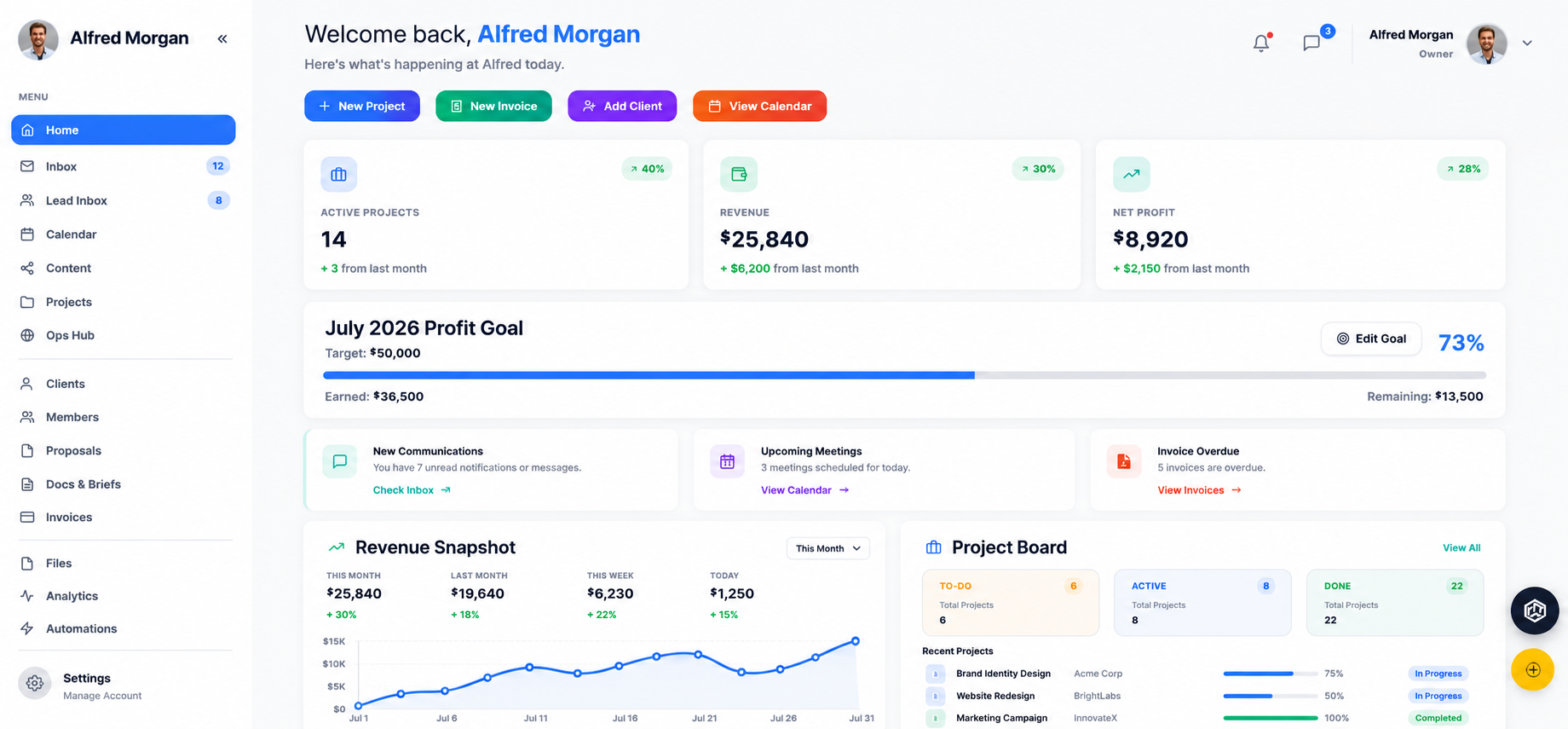
Arpixa dashboard showing sales, projects and billing