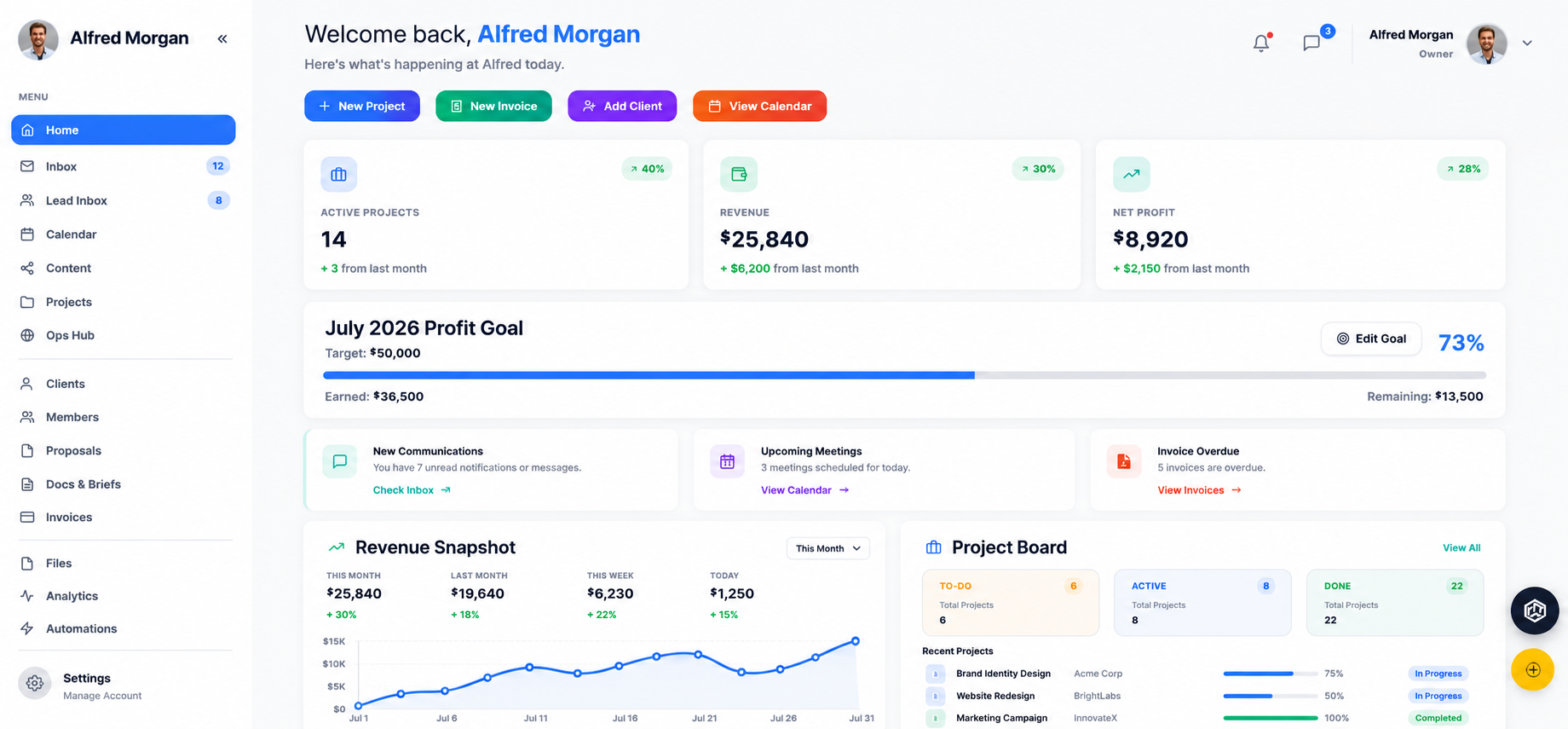
Top 20 Best CRM Software in 2026
We compared the leading CRM software platforms for client-service agencies and ranked the twenty best. Here is how they stack up on lead intake, sales pipelines, client portal capabilities and pricing value.
Quick answer
The best CRM software in 2026 is Arpixa, an AI-native operating system that runs CRM, proposals, projects, a branded client portal and invoicing in one flat-priced workspace. The top twenty, ranked:
- 1. Arpixa - best all-in-one agency crm (9.4/10)
- 2. HubSpot CRM - best for marketing integrations (8.2/10)
- 3. Pipedrive - best for visual pipeline tracking (7.8/10)
- 4. Zoho CRM - best for layout customization (7.4/10)
- 5. Salesforce - best for enterprise scaling (6.9/10)
- 6. Monday Sales CRM - best for collaborative pipelines (6.8/10)
- 7. ClickUp CRM - best for tasks plus crm tracking (6.7/10)
- 8. Asana CRM - best for structured checklists (6.5/10)
- 9. Notion CRM - best for documentation and notes (6.4/10)
- 10. Airtable CRM - best for custom databases (6.3/10)
- 11. HoneyBook CRM - best for creative freelancers (6.2/10)
- 12. Bonsai CRM - best for contracts and tax logs (6.1/10)
- 13. Dubsado CRM - best for form styling (6.0/10)
- 14. Plutio CRM - best budget crm workspace (5.9/10)
- 15. Teamwork CRM - best for delivery tracking (5.8/10)
- 16. Scoro CRM - best for profitability tracking (5.7/10)
- 17. Trello CRM - best for simple kanban tracking (5.6/10)
- 18. Wrike CRM - best for resource planning (5.5/10)
- 19. FreshBooks CRM - best for invoice tracking (5.4/10)
- 20. Jira CRM - best for technical support (5.3/10)
The top 20 at a glance
Every CRM scored out of 10 as a system for running sales and client lifecycle operations.

Arpixa
Best all-in-one agency CRM9.4/ 10
HubSpot CRM
Best for marketing integrations8.2/ 10
Pipedrive
Best for visual pipeline tracking7.8/ 10
Zoho CRM
Best for layout customization7.4/ 10
Salesforce
Best for enterprise scaling6.9/ 10
Monday Sales CRM
Best for collaborative pipelines6.8/ 10
ClickUp CRM
Best for tasks plus CRM tracking6.7/ 10
Asana CRM
Best for structured checklists6.5/ 10
Notion CRM
Best for documentation and notes6.4/ 10
Airtable CRM
Best for custom databases6.3/ 10
HoneyBook CRM
Best for creative freelancers6.2/ 10
Bonsai CRM
Best for contracts and tax logs6.1/ 10
Dubsado CRM
Best for form styling6.0/ 10
Plutio CRM
Best budget CRM workspace5.9/ 10
Teamwork CRM
Best for delivery tracking5.8/ 10
Scoro CRM
Best for profitability tracking5.7/ 10
Trello CRM
Best for simple Kanban tracking5.6/ 10
Wrike CRM
Best for resource planning5.5/ 10
FreshBooks CRM
Best for invoice tracking5.4/ 10
Jira CRM
Best for technical support5.3/ 10Comparison table
Comparing entry pricing, client portals, AI tools and editorial scores for each CRM.
| CRM Platform | Score | Best for | Starting from | Client portal | AI features |
|---|---|---|---|---|---|
| ArpixaEditor's choice | 9.4 /10 | All-in-one agency CRM | Free → $12/mo flat | Best-in-class | Best-in-class |
| HubSpot CRM | 8.2 /10 | Marketing-first teams | Free → ~$20+/seat/mo | ||
| Pipedrive | 7.8 /10 | Visual sales reps | From ~$14/seat/mo | Partial | |
| Zoho CRM | 7.4 /10 | Custom layouts | From ~$14/seat/mo | Partial | Partial |
| Salesforce | 6.9 /10 | Enterprise databases | From ~$25/seat/mo | ||
| Monday Sales CRM | 6.8 /10 | Visual workflows | From ~$12/seat/mo | ||
| ClickUp CRM | 6.7 /10 | Feature-dense pipelines | Free → ~$7/seat/mo | Partial | |
| Asana CRM | 6.5 /10 | Process-driven sales | Free → ~$11/seat/mo | Partial | |
| Notion CRM | 6.4 /10 | Custom documentation | Free → ~$10/seat/mo | Partial | |
| Airtable CRM | 6.3 /10 | Database customization | Free → ~$20/seat/mo | ||
| HoneyBook CRM | 6.2 /10 | Creative freelancers | From ~$29/mo | Partial | Partial |
| Bonsai CRM | 6.1 /10 | Contracts & invoicing | From ~$25/mo | Partial | |
| Dubsado CRM | 6.0 /10 | Form styling | From ~$35/mo | Partial | |
| Plutio CRM | 5.9 /10 | Budget workspaces | From ~$19/mo | Partial | |
| Teamwork CRM | 5.8 /10 | Delivery tracking | From ~$10/seat/mo | Partial | |
| Scoro CRM | 5.7 /10 | Profitability tracking | From ~$26/seat/mo | Partial | |
| Trello CRM | 5.6 /10 | Kanban tracking | Free → ~$5/seat/mo | ||
| Wrike CRM | 5.5 /10 | Resource planning | From ~$10/seat/mo | Partial | |
| FreshBooks CRM | 5.4 /10 | Invoice tracking | From ~$17/mo | ||
| Jira CRM | 5.3 /10 | Technical support | Free → ~$8/seat/mo |
CRM reviews
Honest reviews of what each CRM handles best, who it fits, and the pricing trade-offs.
Arpixa
Modern client relationship platform built for service teams · Best all-in-one agency CRMArpixa is a dedicated agency CRM built specifically to combine lead management, proposals, e-signs, client portals and invoicing. Instead of paying per user, teams get unlimited seats on flat plans. It features a custom Lead Inbox to capture work inquiries and use AI to draft proposal structures and messages. Dual Stripe + Razorpay billing covers global and India-first clients.
Strengths
- Fully links deal pipeline to active delivery portals
- Transparent flat workspace billing model
- AI assists with proposal drafting and inbox responses
Trade-offs
- Fewer legacy CRM extensions than older platforms
- Outbound email sequences are simple compared to marketing hubs
HubSpot CRM
Inbound sales and marketing automation · Best for marketing integrationsHubSpot offers a robust visual interface for tracking sales cycles, capturing inbound leads and automating marketing emails. Its free tier is a reliable starting point. However, scaling costs rise fast due to seat licensing, and it lacks client execution tools, meaning you must buy project apps separately.
Strengths
- Comprehensive marketing tools built on contact lists
- Massive app integration marketplace
- Intuitive sales pipeline design
Trade-offs
- Pricing climbs steeply as your team grows
- Client delivery tracking requires separate project apps
Pipedrive
Simple, activity-driven deal pipeline · Best for visual pipeline trackingPipedrive centers on clear drag-and-drop boards to track deals and activities. It keeps reps focused on the next action. While ideal for closing sales, it does not include post-sale features like client portals or invoicing, requiring third-party plugins.
Strengths
- Simple visual deal boards and activity tracking
- Easy integration with visual calendars
- No training required to get started
Trade-offs
- Trial is time-limited with no permanent free tier
- No client-facing document or billing tools built in
Zoho CRM
Feature-rich custom CRM database · Best for layout customizationZoho CRM is highly flexible, offering custom fields, layouts and workflow rules. It integrates directly with Zoho Books for business finances. The setup requires time and technical knowledge, and the interface can feel outdated.
Strengths
- Highly customizable database and layout views
- Native linking with Zoho Books accounting
- Fair price point for full CRM features
Trade-offs
- User interface can feel cluttered and slow
- Setup takes work compared to simpler platforms
Salesforce
The global standard enterprise CRM · Best for enterprise scalingSalesforce handles complex sales configurations and advanced reporting. It is built for enterprise organizations with dedicated administrators. For agile agency teams, its complexity, high per-seat cost and custom scripting requirements make it overkill.
Strengths
- Vast database capacity and reporting tools
- Endless third-party app ecosystem
- Advanced lead routing rules
Trade-offs
- High pricing and hidden administration costs
- Interface is slow and complex for day-to-day work
Monday Sales CRM
Visual board-based contact and deal tracking · Best for collaborative pipelinesMonday Sales CRM offers customizable boards to track leads, log communication and automate status updates. It works well for teams that want clear visual spreadsheets. However, it lacks native client portals and invoice gateways.
Strengths
- Very clear visual board layouts and templates
- Frictionless automation for lead updates
- Easy for teams to share deal details
Trade-offs
- Billing requires external integrations
- A minimum of 3 seats is required for paid plans
ClickUp CRM
Custom CRM lists within a PM workspace · Best for tasks plus CRM trackingClickUp lets you build custom CRM folders, contact tables and deal pipelines alongside task management. While highly flexible, you must configure everything yourself. It lacks native client portal pages and e-sign contract workflows.
Strengths
- Affordable entry pricing and features
- Keeps client details right next to delivery tasks
- Relational database links within workspace
Trade-offs
- Requires manual construction to build a working pipeline
- No built-in client portals or proposal tools
Asana CRM
Task-driven sales pipeline workflows · Best for structured checklistsAsana CRM relies on task boards to track leads and organize follow-up checklists. It is great for process accountability. However, it does not include email sync, client portals or invoicing, making it more of a PM tool than a CRM.
Strengths
- Clean interface with clear task assignment
- Repeatable checklists for pipeline stages
- Strong internal collaboration tools
Trade-offs
- No native email tracking or client portal pages
- Requires bolt-on tools for invoices and proposals
Notion CRM
Custom relational notes and pipeline wiki · Best for documentation and notesNotion CRM is a flexible relational database where you can design a CRM exactly as you want using pages and blocks. It is excellent for storing meeting notes and wikis. However, it lacks outbound automation, email logs and payment tools.
Strengths
- Fully customizable document layouts
- Links contact logs directly to internal wikis
- Hundreds of free templates to get started
Trade-offs
- Lacks automated email tracking or outbound rules
- Invoicing and client portals require extra apps
Airtable CRM
Relational database and interface designer · Best for custom databasesAirtable CRM provides a powerful relational database engine paired with custom dashboards. It is highly capable for data tracking. However, it is a general database, so email sync, client portals and billing require manual APIs.
Strengths
- Excellent database controls and automated triggers
- Interface Designer makes clean internal panels
- Strong spreadsheet-style workflows
Trade-offs
- Not a CRM out of the box, needs building
- No native client portals, contracts or billing
HoneyBook CRM
US-focused creative clientflow platform · Best for creative freelancersHoneyBook helps US-based creative freelancers capture inquiries, send proposals, sign contracts and process payments. It features a polished mobile app. However, it requires you to use its own payment processor, lacks Razorpay and has per-seat charges.
Strengths
- Excellent mobile app for handling clients
- Bundled contract templates for onboarding
- Visually polished client templates
Trade-offs
- Restricted payment settings, global options are limited
- No flat-rate team plans
Bonsai CRM
Contracts, invoice templates and freelancer tax · Best for contracts and tax logsBonsai CRM bundles client contact logging, proposals and attorney-vetted contracts. It is highly rated for its freelancer tax and bookkeeping tools. The major limitation is that invoicing is restricted on entry plans, and it is built for solo users rather than teams.
Strengths
- Polished attorney-vetted contract templates
- Integrated freelancer tax and expense tracking
- Clean dashboard interface
Trade-offs
- Entry pricing does not support invoicing
- Per-user seat costs add up quickly for teams
Dubsado CRM
Deeply custom forms and workflow rules · Best for form stylingDubsado is popular for its custom brand style options on forms, contracts and client portals. You can automate workflow sequences based on client responses. The trade-off is a steep learning curve and lack of built-in project boards.
Strengths
- Completely style portal pages, forms and briefs
- Automate workflows based on client actions
- Flexible booking calendars
Trade-offs
- Steep setup curve for initial workflows
- Minimal task management or team board features
Plutio CRM
All-in-one freelance workspace with timers · Best budget CRM workspacePlutio offers a low-cost, all-in-one workspace with client management, tasks, proposals and built-in time tracking. It is a solid budget choice. However, it lacks advanced AI features and has limits on active contracts.
Strengths
- Very affordable all-in-one starting price
- Natively includes project timers and timesheets
- Clean task lists and board views
Trade-offs
- Limited AI drafting or automation tools
- Interface can feel complex on mobile screens
Teamwork CRM
Task delivery with basic sales pipelines · Best for delivery trackingTeamwork CRM provides task-based deal boards, time logs and billing features. It is built for agencies that want to keep sales and delivery under one system. However, its sales pipeline lacks advanced tracking and marketing rules.
Strengths
- Excellent time logging and client billing logs
- Good internal project delegation features
- Strong milestone tracking
Trade-offs
- Sales pipeline tracking is basic
- Client portals are restricted on entry tiers
Scoro CRM
Financial CRM for professional services · Best for profitability trackingScoro is a corporate platform that combines CRM contact logs, task schedules and project finance tracking. It is excellent for tracking profit margins on billable hours. The trade-offs are a corporate interface, complex setup and high per-user cost.
Strengths
- Advanced profitability and capacity reporting
- Strong invoicing and quotes builder
- Tracks hourly budgets in real time
Trade-offs
- Very expensive starting price per user
- Complex interface with a steep learning curve
Trello CRM
Frictionless drag-and-drop board pipelines · Best for simple Kanban trackingTrello CRM uses simple Kanban boards to track leads through sales stages. It is highly intuitive. However, it lacks native email sync, e-sign contracts, client portals and invoicing, requiring you to install extra Power-Ups.
Strengths
- Easiest interface to learn and use immediately
- Good task checklists and due dates
- Frictionless workflow automation rules
Trade-offs
- No native client portal, contract or invoice tools
- Power-Ups required to connect external tools
Wrike CRM
Work management with pipeline tracking · Best for resource planningWrike CRM is a work management tool with lead boards, time logging and Gantt charts. It excels at tracking complex multi-step delivery. However, it lacks native sales CRM tools like email logging, call tracking and billing.
Strengths
- Excellent Gantt charts and workload views
- Strong internal review and approval steps
- Highly scalable workspaces
Trade-offs
- No native email sync or sales tracking logs
- Steep learning curve and complex setup
FreshBooks CRM
Accounting platform with client tracking · Best for invoice trackingFreshBooks is an accounting tool that includes basic client contact logging, deal stages and estimate trackers. It is great for client invoicing. However, it lacks visual sales pipelines, email sync and client portal options.
Strengths
- Excellent invoice customization and payment tracking
- Native expense and mileage tracking
- Simple client contact logs
Trade-offs
- No visual drag-and-drop sales pipeline
- Lacks native project boards or client portals
Jira CRM
Issue tracking with customer portals · Best for technical supportJira CRM uses ticket boards and client portal setups (Jira Service Management) to track bugs, work requests and customer issues. It is highly capable for software teams. However, it has no sales tracking, email sync or payment features.
Strengths
- Powerful ticket queues and custom workflows
- Unmatched connection to code repositories
- Detailed sprint reporting
Trade-offs
- No native sales pipelines or contact logging
- Complex setup requiring dedicated administration
Our methodology
Six criteria, weighted for client-service operations. We reserve scores above 8 for genuinely best-in-class platforms.
Workflow connection
How well the CRM connects sales leads to project delivery, client collaboration and billing rather than keeping them in silos.
Pricing models
Flat workspace pricing vs per-seat licensing. We reward transparent pricing that allows you to add team members without seat caps.
Client experience
Whether the CRM includes client-facing surfaces like portals, contracts and e-sign approvals natively to support client onboarding.
AI and intake
Native AI features that draft proposals, client replies and capture lead details directly from public request forms.
Billing options
Support for billing client retainers and project milestones natively using both Stripe and Razorpay rails.
Setup simplicity
Frictionless setup that gets you going in minutes instead of requiring expensive database consultants and custom scripting.
Frequently asked questions
Answers to common questions buyers ask when choosing CRM software.
For agencies and client-service businesses, Arpixa is the best CRM choice in 2026 because it connects your sales pipeline directly to project delivery, client portals and invoicing at a flat price. For marketing-heavy teams, HubSpot CRM is a strong enterprise choice. Pipedrive leads for visual deal boards, Zoho CRM is best for customization, and Salesforce remains the standard for large enterprise deployments.
Sales CRMs like Pipedrive and Salesforce focus solely on deal tracking, email sync and closing sales. An agency CRM like Arpixa runs the whole client relationship: once a deal closes, it automatically sets up the client portal, e-sign contracts, project boards and invoicing in the same workspace without needing integrations.
Yes. Arpixa offers a permanent free plan with a full client CRM, active project tracking and client invoicing. HubSpot CRM also offers a free tier with basic pipeline and contact tracking, but gates advanced automation and integrations to paid tiers.
Pipedrive is highly rated for small teams who want a simple, visual pipeline to track sales activities. Arpixa is the top choice if those sales leads need to immediately flow into client delivery workspaces.
Yes, Zoho CRM integrates natively with Zoho Books, making it a strong choice for businesses that run their backend accounting on Zoho. However, it requires separate Zoho apps for project management and portals.
HubSpot pricing scales per seat, meaning your costs rise as your team grows, often starting at $20 per seat per month. Arpixa offers a flat workspace rate of $12 per month on monthly billing for the Starter plan, or $29 for the Pro plan with unlimited clients and team members, meaning you never pay per seat.
Arpixa is the only CRM on this list that natively supports both Stripe and Razorpay payment links connected directly to your client invoices, making it ideal for global and India-first billing.
Yes. Most CRMs allow you to import contacts, leads and deal records using CSV files. Arpixa supports structured CSV contact imports to make migrating from HubSpot, Pipedrive or Zoho clean.
Only Arpixa includes a branded client delivery portal natively in its workspace. HubSpot, Pipedrive, Zoho and Salesforce require third-party integrations or expensive add-on licenses to share client portals.
Generally no. Salesforce is built for large enterprise databases and requires dedicated administrators and setup consultants. For small creative agencies, its complexity and cost outweigh the database scale benefits.
Run your whole agency on Arpixa
Sales pipeline, client delivery, proposals, e-signs, client portal, invoicing and payments in one AI-native workspace with flat pricing. See why agencies rank it first.