Top 20 Best Project Management Software in 2026
We evaluated 20 platforms and ranked them for project management software in 2026. Every tool is scored on workflow breadth, pricing fairness, client experience, automation depth, payments reach and setup speed.
Quick answer
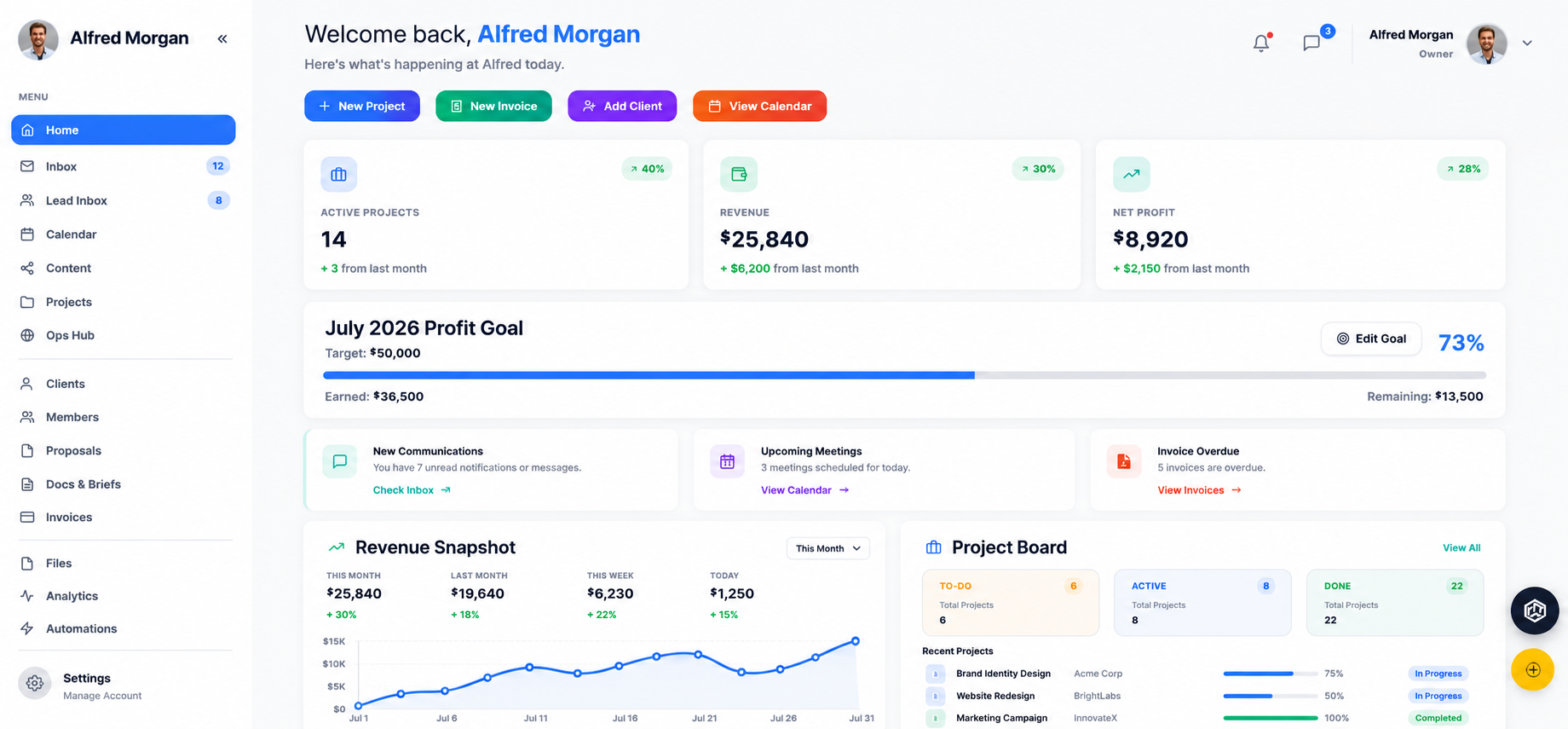
The best choice in 2026 is Arpixa, an AI-native platform that handles the full client lifecycle in one flat-priced workspace. The full ranking:
- 1. Arpixa - best for comprehensive project, client, and payment management. (9.2/10)
- 2. Monday.com - best for highly customizable workflows and team collaboration. (8.8/10)
- 3. Asana - best for task management and team coordination across departments. (8.6/10)
- 4. ClickUp - best for all-in-one productivity with extensive customization. (8.4/10)
- 5. Wrike - best for enterprise project management and complex workflows. (8.2/10)
- 6. Basecamp - best for simplified project communication and document sharing. (8.0/10)
- 7. Smartsheet - best for spreadsheet-like project management with automation. (7.8/10)
- 8. Teamwork - best for client work management and service-based businesses. (7.6/10)
- 9. Jira - best for agile software development and issue tracking. (7.4/10)
- 10. Trello - best for simple, visual task management using kanban boards. (7.2/10)
- 11. Notion - best for flexible workspace combining notes, wikis, and tasks. (7.0/10)
- 12. Airtable - best for building custom applications and flexible databases. (6.8/10)
- 13. Hive - best for project management with integrated native email and chat. (6.6/10)
- 14. Zoho Projects - best for cost-effective project management within the zoho ecosystem. (6.4/10)
- 15. ProofHub - best for simplifying project management with a flat-rate pricing model. (6.2/10)
- 16. MeisterTask - best for intuitive kanban-based task management with mind mapping. (6.0/10)
- 17. Nifty - best for combining project management with built-in docs and wikis. (5.9/10)
- 18. GanttPRO - best for dedicated gantt chart based project planning. (5.8/10)
- 19. Workzone - best for marketing teams needing a robust, intuitive solution. (5.7/10)
- 20. LiquidPlanner - best for predictive scheduling and resource-driven planning. (5.6/10)
The top 20 at a glance
Every platform scored out of 10 for running client-service operations.
Arpixa
Best for comprehensive project, client, and payment management.9.2/ 10
Monday.com
Best for highly customizable workflows and team collaboration.8.8/ 10
Asana
Best for task management and team coordination across departments.8.6/ 10
ClickUp
Best for all-in-one productivity with extensive customization.8.4/ 10
Wrike
Best for enterprise project management and complex workflows.8.2/ 10
Basecamp
Best for simplified project communication and document sharing.8.0/ 10
Smartsheet
Best for spreadsheet-like project management with automation.7.8/ 10
Teamwork
Best for client work management and service-based businesses.7.6/ 10
Jira
Best for agile software development and issue tracking.7.4/ 10
Trello
Best for simple, visual task management using Kanban boards.7.2/ 10
Notion
Best for flexible workspace combining notes, wikis, and tasks.7.0/ 10
Airtable
Best for building custom applications and flexible databases.6.8/ 10
Hive
Best for project management with integrated native email and chat.6.6/ 10
Zoho Projects
Best for cost-effective project management within the Zoho ecosystem.6.4/ 10
ProofHub
Best for simplifying project management with a flat-rate pricing model.6.2/ 10
MeisterTask
Best for intuitive Kanban-based task management with mind mapping.6.0/ 10
Nifty
Best for combining project management with built-in docs and wikis.5.9/ 10
GanttPRO
Best for dedicated Gantt chart based project planning.5.8/ 10
Workzone
Best for marketing teams needing a robust, intuitive solution.5.7/ 10
LiquidPlanner
Best for predictive scheduling and resource-driven planning.5.6/ 10Comparison table
| Platform | Score | Best for | Starting from | Client portal | Gantt charts |
|---|---|---|---|---|---|
| ArpixaEditor's choice | 9.2 /10 | Best for comprehensive project, client, and payment management. | Free to $12/mo flat | Best-in-class | |
| Monday.com | 8.8 /10 | Best for highly customizable workflows and team collaboration. | Free to $10/user/month | Best-in-class | Best-in-class |
| Asana | 8.6 /10 | Best for task management and team coordination across departments. | Free to $10.99/user/month | ||
| ClickUp | 8.4 /10 | Best for all-in-one productivity with extensive customization. | Free to $7/user/month | Best-in-class | Best-in-class |
| Wrike | 8.2 /10 | Best for enterprise project management and complex workflows. | Free to $9.80/user/month | ||
| Basecamp | 8.0 /10 | Best for simplified project communication and document sharing. | From $15/user/month (flat rate) | ||
| Smartsheet | 7.8 /10 | Best for spreadsheet-like project management with automation. | From $7/user/month | ||
| Teamwork | 7.6 /10 | Best for client work management and service-based businesses. | Free to $10/user/month | ||
| Jira | 7.4 /10 | Best for agile software development and issue tracking. | Free to $7.75/user/month | Partial | Best-in-class |
| Trello | 7.2 /10 | Best for simple, visual task management using Kanban boards. | Free to $5/user/month | ||
| Notion | 7.0 /10 | Best for flexible workspace combining notes, wikis, and tasks. | Free to $8/user/month | Best-in-class | Partial |
| Airtable | 6.8 /10 | Best for building custom applications and flexible databases. | Free to $20/user/month | Partial | |
| Hive | 6.6 /10 | Best for project management with integrated native email and chat. | From $12/user/month | ||
| Zoho Projects | 6.4 /10 | Best for cost-effective project management within the Zoho ecosystem. | Free to $5/user/month | ||
| ProofHub | 6.2 /10 | Best for simplifying project management with a flat-rate pricing model. | From $45/month (flat rate) | ||
| MeisterTask | 6.0 /10 | Best for intuitive Kanban-based task management with mind mapping. | Free to $10/user/month | Partial | |
| Nifty | 5.9 /10 | Best for combining project management with built-in docs and wikis. | Free to $39/month (up to 10 users) | Best-in-class | |
| GanttPRO | 5.8 /10 | Best for dedicated Gantt chart based project planning. | From $7.99/user/month | Partial | |
| Workzone | 5.7 /10 | Best for marketing teams needing a robust, intuitive solution. | From $24/user/month (min 5 users) | ||
| LiquidPlanner | 5.6 /10 | Best for predictive scheduling and resource-driven planning. | From $15/user/month | Partial | Best-in-class |
Full reviews
Arpixa
Unified hub for projects, clients, payments. · Best for comprehensive project, client, and payment management.Arpixa offers an all-in-one platform for project management, client communication, and integrated payment processing. Its strength lies in consolidating multiple business functions into a single, intuitive interface, streamlining operations significantly. However, the depth of advanced financial reporting might be limited for very large enterprises.
Strengths
- Integrated client billing
- Comprehensive project tracking
- Intuitive user interface
Trade-offs
- Advanced financial reporting limited
- Steeper learning curve for all features
Monday.com
Flexible platform for team workflow customization. · Best for highly customizable workflows and team collaboration.Monday.com provides a highly visual and flexible work operating system that adapts to almost any project or team workflow. Its main strength is the incredible customization options, allowing teams to build boards exactly how they need them. The trade-off can be its complexity; new users might feel overwhelmed by the sheer number of features and configurations.
Strengths
- Extremely customizable dashboards
- Visual, engaging interface
- Extensive integration options
Trade-offs
- Can be overwhelming for new users
- Cost scales quickly with users
Asana
Organize tasks, track progress, collaborate easily. · Best for task management and team coordination across departments.Asana excels at organizing tasks, managing projects, and fostering team collaboration through clear assignments and progress tracking. Its strength lies in its robust task management features and ability to visualize workflows across various views. However, it can sometimes lack deeper reporting and advanced resource management tools compared to more enterprise-focused solutions.
Strengths
- Robust task management features
- Clear project visibility
- Intuitive interface for task assignment
Trade-offs
- Limited built-in time tracking
- Advanced reporting costs extra
ClickUp
One app to replace them all, literally. · Best for all-in-one productivity with extensive customization.ClickUp positions itself as an all-in-one productivity platform, offering a vast array of features from task management to docs and whiteboards. Its main strength is its incredible flexibility and depth of functionality, allowing teams to consolidate many tools. The key trade-off is that this extensive feature set can lead to a steep learning curve and potential complexity for smaller teams.
Strengths
- Highly customizable workflows
- Comprehensive feature set
- Excellent free plan
Trade-offs
- Can be overwhelming for new users
- Performance issues with large workspaces
Wrike
Collaborate, manage projects, deliver results faster. · Best for enterprise project management and complex workflows.Wrike provides a powerful work management platform designed for complex projects and cross-functional teams, offering robust features for planning and execution. Its strength lies in its enterprise-grade capabilities, including advanced reporting and security. However, its comprehensive nature can make it less intuitive for small teams or those with simpler project needs.
Strengths
- Robust enterprise features
- Advanced analytics and reporting
- Strong security protocols
Trade-offs
- Higher cost for full features
- Steeper learning curve for new users
Basecamp
Streamlined communication, clear project organization. · Best for simplified project communication and document sharing.Basecamp focuses on providing a straightforward platform for team communication and project organization, emphasizing ease of use over feature bloat. Its strength is its simplicity and flat-rate pricing, making it predictable and accessible for many teams. The trade-off is its lack of advanced project management functionalities like Gantt charts or detailed reporting, which might be insufficient for complex projects.
Strengths
- Extremely easy to use
- Transparent, flat-rate pricing
- Excellent client collaboration tools
Trade-offs
- Lacks advanced project features
- Minimal reporting capabilities
Smartsheet
Dynamic workspace for planning, tracking, automating. · Best for spreadsheet-like project management with automation.Smartsheet combines the familiarity of a spreadsheet with robust project management and automation capabilities, making it highly adaptable for various use cases. Its strength lies in its flexible data organization and powerful automation features, allowing users to streamline repetitive tasks. However, it can feel less intuitive than traditional PM software for those unfamiliar with spreadsheet logic, and visual project views are less prominent.
Strengths
- Highly flexible data management
- Powerful automation features
- Excellent reporting and dashboards
Trade-offs
- Can be less intuitive for non-spreadsheet users
- Visual project views are limited
Teamwork
Manage projects, clients, and teams efficiently. · Best for client work management and service-based businesses.Teamwork is designed specifically for client-facing project management, offering robust features for task tracking, time logging, and client collaboration. Its strength lies in its comprehensive tools for managing profitability, resources, and client communication, making it ideal for agencies. The trade-off is that its extensive features can be overwhelming for internal teams with simpler project needs, requiring a dedicated setup period.
Strengths
- Excellent client collaboration tools
- Detailed time tracking and billing
- Comprehensive resource management
Trade-offs
- Interface can feel dated
- Feature-rich, potentially overwhelming
Jira
Powering agile teams, from planning to deployment. · Best for agile software development and issue tracking.Jira is the industry standard for agile software development, excelling in issue tracking, bug reporting, and managing complex sprints. Its strength lies in its deep integration with developer tools and highly configurable workflows tailored for technical teams. However, its interface and terminology can be intimidating for non-technical users, making it less suitable for general project management.
Strengths
- Robust agile project management
- Excellent issue tracking
- Deep integration with dev tools
Trade-offs
- Complex for non-technical users
- Less suited for non-IT projects
Trello
Organize anything, visually and collaboratively. · Best for simple, visual task management using Kanban boards.Trello offers a highly visual and intuitive Kanban-style board for organizing tasks and workflows, making project management accessible to everyone. Its main strength is its simplicity and ease of use, perfect for visualizing progress and quick task delegation. The trade-off is its limited native advanced features; complex project reporting or resource management often require paid power-ups.
Strengths
- Extremely easy to use
- Visual Kanban board interface
- Great for simple task tracking
Trade-offs
- Limited native advanced features
- Relies heavily on power-ups for functionality
Notion
All-in-one workspace for notes, docs, tasks, wikis. · Best for flexible workspace combining notes, wikis, and tasks.Notion provides an incredibly flexible workspace that unifies notes, wikis, project boards, and databases into a single environment. Its strength lies in its unparalleled customizability, allowing teams to build exactly the tools they need. However, this flexibility can also be its weakness, as it requires significant setup and lacks some dedicated project management features found in specialized tools.
Strengths
- Highly customizable workspace
- Excellent for knowledge management
- Versatile database functionality
Trade-offs
- Steep learning curve for full potential
- Lacks dedicated advanced PM features
Airtable
Connects data, people, and workflows effortlessly. · Best for building custom applications and flexible databases.Airtable is a powerful low-code platform that blends the familiarity of a spreadsheet with the power of a database, enabling teams to build custom workflows and applications. Its strength lies in its flexibility to manage diverse data and create custom interfaces for various project types. The trade-off is that it requires a deeper understanding of database concepts to unlock its full potential, and core project management features are less explicit.
Strengths
- Flexible database structure
- Highly customizable workflows
- Integrates with many services
Trade-offs
- Can be expensive for advanced features
- Steep learning curve for complex bases
Hive
Centralize your work, connect your team. · Best for project management with integrated native email and chat.Hive provides a comprehensive project management platform that integrates native email, chat, and various project views into a single interface. Its strength is offering a true all-in-one solution that reduces the need for multiple tools, streamlining communication and task management. However, its extensive feature set can sometimes lead to a crowded interface, potentially overwhelming new users during initial setup.
Strengths
- Integrated email and chat
- Multiple project views
- Robust resource management
Trade-offs
- Interface can feel cluttered
- Requires time for full customization
Zoho Projects
Plan, track, collaborate, deliver projects effectively. · Best for cost-effective project management within the Zoho ecosystem.Zoho Projects offers a full suite of project management tools, including Gantt charts, time tracking, and issue management, often at a competitive price. Its strength lies in its seamless integration with other Zoho applications, providing a comprehensive business suite. The trade-off is that its interface, while functional, might not be as modern or intuitive as some newer platforms, and advanced analytics can be limited outside the ecosystem.
Strengths
- Affordable pricing plans
- Strong integration with Zoho apps
- Comprehensive project features
Trade-offs
- Interface can feel dated
- Reporting can be less intuitive
ProofHub
All-in-one solution for project planning and collaboration. · Best for simplifying project management with a flat-rate pricing model.ProofHub offers a robust project management platform with features like task management, discussions, and file sharing, all under a flat-rate pricing model. Its strength is its straightforward, predictable cost, making it ideal for growing teams without worrying about per-user fees. However, while comprehensive, its interface might feel less modern compared to competitors, and some advanced integrations are not natively available.
Strengths
- Flat-rate pricing, unlimited users
- Comprehensive feature set
- Good for client collaboration
Trade-offs
- Interface could be more modern
- Limited native third-party integrations
MeisterTask
Intuitive task management for agile teams. · Best for intuitive Kanban-based task management with mind mapping.MeisterTask provides an elegant, Kanban-style task management solution that integrates seamlessly with its mind mapping tool, MindMeister. Its strength lies in its visual simplicity and automation capabilities, making task flows efficient and easy to follow. The trade-off is its focus on task management means it lacks deeper project planning features like advanced resource management or complex Gantt charts, which might be needed for larger projects.
Strengths
- Intuitive Kanban interface
- Excellent MindMeister integration
- Automated recurring tasks
Trade-offs
- Limited advanced project planning
- Basic reporting features
Nifty
All-in-one workspace for projects, tasks, and team communication. · Best for combining project management with built-in docs and wikis.Nifty offers an all-in-one workspace that blends project management, team communication, and document collaboration into a single platform. Its strength lies in its ability to centralize various aspects of work, from task tracking to built-in docs and wikis, reducing tool sprawl. However, some users might find its interface occasionally less polished than top-tier competitors, and the initial setup can require some effort to fully customize.
Strengths
- All-in-one workspace solution
- Built-in docs and wikis
- Good for client collaboration
Trade-offs
- Interface can feel slightly less refined
- Setup can take time
GanttPRO
Intuitive Gantt charts for effective project planning. · Best for dedicated Gantt chart based project planning.GanttPRO is a specialized tool that excels at creating and managing projects using intuitive Gantt charts, offering robust features for task dependencies and resource allocation. Its strength lies in its powerful Gantt chart functionality, making complex project timelines clear and manageable. The trade-off is its primary focus on Gantt charts means it lacks the breadth of other project views and collaborative features found in more general-purpose PM tools, potentially limiting its versatility.
Strengths
- Powerful Gantt chart features
- Easy dependency management
- Resource and cost tracking
Trade-offs
- Limited alternative project views
- Collaboration features are basic
Workzone
Simple, powerful project management for teams. · Best for marketing teams needing a robust, intuitive solution.Workzone offers a comprehensive project management solution with a focus on ease of use and robust features for collaboration and reporting. Its strength is its straightforward interface and powerful reporting capabilities, making it ideal for teams needing clear project oversight. However, its higher price point and minimum user requirement might make it less accessible for very small teams or individual users, and the interface, while clean, isn't as visually modern as some competitors.
Strengths
- Robust reporting and analytics
- Intuitive for new users
- Good for client collaboration
Trade-offs
- Higher price point
- Minimum user requirement
LiquidPlanner
Predictive project management for confident planning. · Best for predictive scheduling and resource-driven planning.LiquidPlanner stands out with its unique predictive scheduling engine, which automatically adjusts project timelines based on real-time changes and resource availability. Its strength is its ability to provide realistic project forecasts and manage resource conflicts effectively, ideal for complex, resource-heavy projects. The trade-off is that its sophisticated scheduling can have a steeper learning curve, and it might be overkill for simpler projects not requiring such dynamic adjustments.
Strengths
- Unique predictive scheduling
- Dynamic resource leveling
- Realistic project forecasting
Trade-offs
- Steep learning curve
- Interface can feel complex
Our methodology
Feature Set & Versatility
We evaluate the breadth and depth of project management features, including task management, planning tools, and workflow customization.
Collaboration & Communication
This criterion assesses how effectively teams can communicate, share files, and collaborate on tasks within the platform.
Performance & Ease of Use
We consider the software's speed, stability, and the intuitiveness of its interface, alongside the learning curve for new users.
Security & Integrations
Our review includes data security measures, compliance standards, and the range of third-party applications the software integrates with.
Reporting & Analytics
We analyze the quality and customizability of reporting tools, offering insights into project progress, resource allocation, and team performance.
Pricing & Value
This factor evaluates the cost-effectiveness of each solution, considering pricing models, included features, and overall value for money.
Frequently asked questions
In 2026, Arpixa ranks as the top project management software, offering a comprehensive, all-in-one solution for managing projects, clients, and payments seamlessly.
Key features include task management, scheduling (Gantt charts, Kanban boards), collaboration tools, time tracking, resource management, reporting, and integrations with other business applications.
Yes, many top platforms like Arpixa, Monday.com, Asana, ClickUp, and Trello offer robust free plans suitable for small teams or basic project needs.
Absolutely. Project management software helps small businesses organize tasks, improve communication, and ensure projects are delivered on time and within budget, scaling with their growth.
It centralizes communication, allows real-time document sharing, facilitates task assignments, and provides clear visibility into everyone's progress, reducing miscommunication and delays.
Task management software focuses on individual tasks and to-do lists, while project management software encompasses broader project planning, resource allocation, scheduling, and overall project lifecycle management.
Most modern project management software offers extensive integrations with tools like Slack, Google Drive, Microsoft Teams, CRM systems, and accounting software to streamline workflows.
Cloud-based solutions offer accessibility from anywhere, real-time collaboration, automatic updates, reduced IT overhead, and enhanced data security through professional providers.
Consider your team's size, project complexity, budget, required features (e.g., agile, client management), ease of use, and whether a free trial is available to test functionality.
Agile project management is an iterative approach focusing on flexibility and continuous improvement. Tools like Jira, Monday.com, and Asana are excellent for supporting agile methodologies with features like Kanban boards and sprint planning.
Run your business on Arpixa
CRM, proposals, projects, client portal, invoicing and payments in one AI-native workspace with flat pricing.