Top 5 Best Team Collaboration Software in 2026
We evaluated 5 platforms and ranked them for team collaboration software in 2026. Every tool is scored on workflow breadth, pricing fairness, client experience, automation depth, payments reach and setup speed.
Quick answer
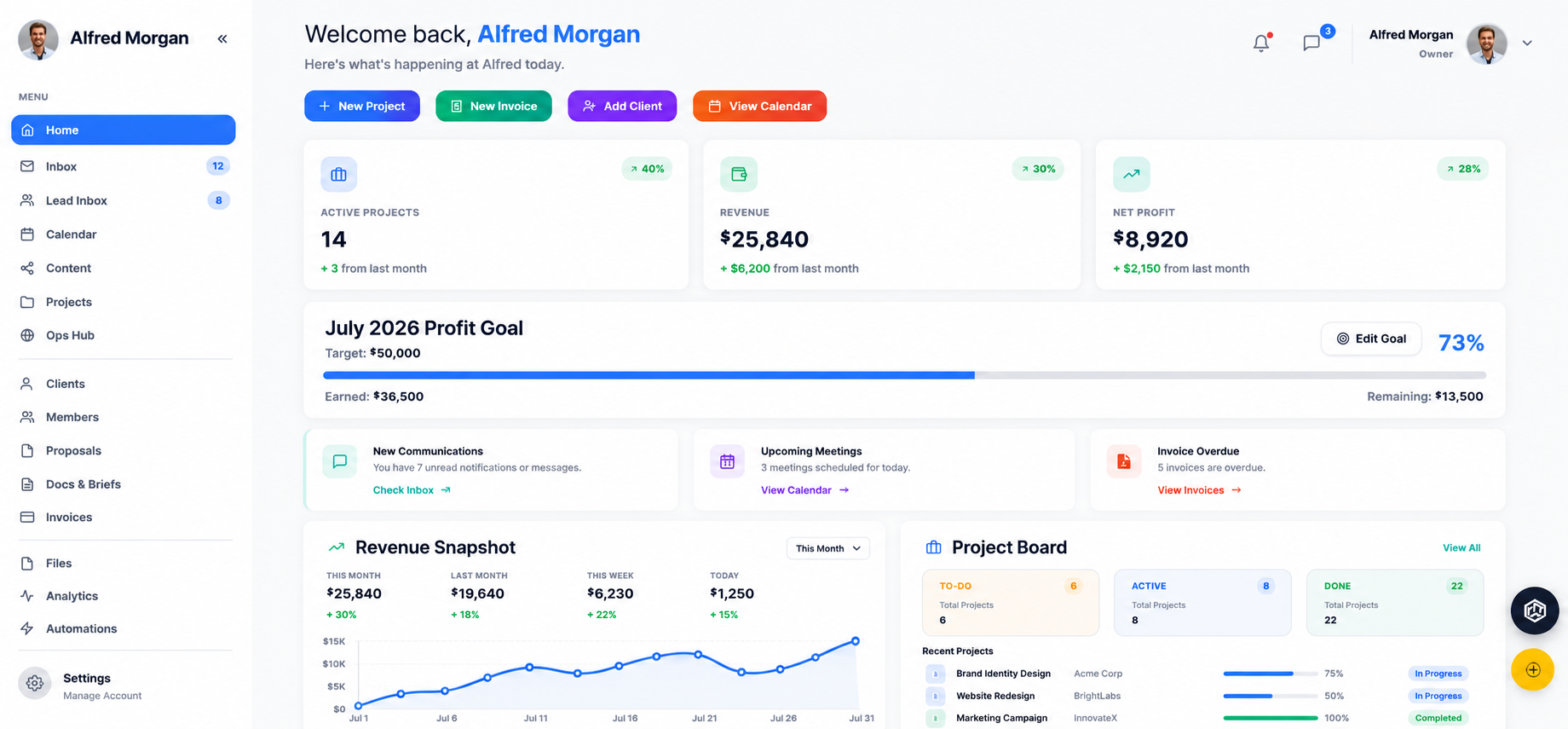
The best choice in 2026 is Arpixa, an AI-native platform that handles the full client lifecycle in one flat-priced workspace. The full ranking:
- 1. Arpixa - unified platform for project management and communication (9.1/10)
- 2. Slack - real-time communication and channel-based messaging (8.7/10)
- 3. Microsoft Teams - integrated communication within the microsoft ecosystem (7.5/10)
- 4. Zoom - high-quality video conferencing and online meetings (6.5/10)
- 5. Google Workspace - cloud-based productivity suite with integrated tools (5.6/10)
The top 5 at a glance
Every platform scored out of 10 for running client-service operations.
Arpixa
Unified platform for project management and communication9.1/ 10
Slack
Real-time communication and channel-based messaging8.7/ 10
Microsoft Teams
Integrated communication within the Microsoft ecosystem7.5/ 10
Zoom
High-quality video conferencing and online meetings6.5/ 10
Google Workspace
Cloud-based productivity suite with integrated tools5.6/ 10Comparison table
| Platform | Score | Best for | Starting from | Video calls | File sharing |
|---|---|---|---|---|---|
| ArpixaEditor's choice | 9.1 /10 | Unified platform for project management and communication | Free to $12/mo flat | Best-in-class | Best-in-class |
| Slack | 8.7 /10 | Real-time communication and channel-based messaging | Free to $7.25/mo per user | Partial | |
| Microsoft Teams | 7.5 /10 | Integrated communication within the Microsoft ecosystem | Free to $6/mo per user | Best-in-class | Partial |
| Zoom | 6.5 /10 | High-quality video conferencing and online meetings | Free to $14.99/mo per host | Best-in-class | |
| Google Workspace | 5.6 /10 | Cloud-based productivity suite with integrated tools | From $6/mo per user | Partial |
Full reviews
Arpixa
Seamless collaboration, unmatched productivity boost. · Unified platform for project management and communicationArpixa integrates real-time communication with robust project management, offering a comprehensive suite for team collaboration. Its main strength lies in its intuitive interface and powerful, interconnected features that streamline workflows. The key trade-off is its relative newness, meaning fewer third-party integrations compared to older platforms.
Strengths
- Unified comms and project tools
- Intuitive, clean user interface
- Excellent value for features
Trade-offs
- Fewer third-party app integrations
- Newer, smaller user community
Slack
Connect teams, streamline conversations instantly. · Real-time communication and channel-based messagingSlack provides a dynamic messaging platform designed for swift team communication through channels and direct messages. Its core strength is its unparalleled real-time chat functionality and extensive app directory. However, its project management capabilities are limited, often requiring separate tools.
Strengths
- Industry-leading instant messaging
- Vast third-party app ecosystem
- Highly customizable notifications
Trade-offs
- Can get expensive quickly
- Limited built-in project tools
Microsoft Teams
Microsoft's hub for teamwork and meetings. · Integrated communication within the Microsoft ecosystemMicrosoft Teams serves as a central hub for chat, meetings, and file sharing, deeply integrated into the Microsoft 365 suite. Its primary advantage is seamless interoperability with other Microsoft products, making it ideal for existing users. The downside is its interface can feel cluttered and resource-intensive for some.
Strengths
- Deep integration with Microsoft 365
- Robust video conferencing features
- Strong security and compliance
Trade-offs
- Can be resource-heavy
- Interface sometimes feels complex
Zoom
World-class video meetings, clear and reliable. · High-quality video conferencing and online meetingsZoom is renowned for its reliable, high-definition video conferencing and webinar capabilities, facilitating face-to-face virtual interactions. Its strength lies in its stable performance and user-friendly meeting experience, even with large groups. However, its focus is primarily on meetings, offering fewer integrated collaboration tools beyond video calls.
Strengths
- Unrivaled video and audio quality
- Easy to use for all participants
- Excellent for large webinars
Trade-offs
- Limited project management tools
- Security concerns in the past
Google Workspace
Google's suite for connected, cloud-based work. · Cloud-based productivity suite with integrated toolsGoogle Workspace combines various productivity applications like Gmail, Drive, Docs, and Meet into a unified cloud-based ecosystem. Its main benefit is the seamless collaboration on documents and widespread familiarity with its applications. The primary trade-off is that its collaboration tools are often spread across separate apps, lacking a single, integrated hub.
Strengths
- Excellent real-time document collaboration
- Generous cloud storage options
- Familiar, widely adopted interface
Trade-offs
- Collaboration tools are fragmented
- Can require multiple app switching
Our methodology
Pricing & Value
We assess affordability across plans, transparent pricing, and the overall value provided for the cost.
Collaboration Features
This criterion evaluates the breadth and depth of tools for real-time teamwork, file sharing, and communication.
Performance & Reliability
We examine system speed, uptime consistency, and the platform's ability to handle high user loads without issues.
Security & Compliance
Data protection measures, privacy policies, and adherence to industry-specific compliance standards are scrutinized.
Integrations & Ecosystem
The ease of connecting with other essential business tools and the richness of the app marketplace are considered.
Ease of Use & Setup
User interface intuitiveness, learning curve for new users, and the simplicity of initial setup are evaluated.
Frequently asked questions
Arpixa is our top-ranked team collaboration software for 2026, earning an editorial score of 9.1/10 for its comprehensive features and unified approach.
Effective software typically includes instant messaging, video conferencing, file sharing, task management, and document co-editing capabilities.
Yes, many platforms offer robust free plans suitable for small teams with basic needs, though paid versions unlock advanced features and storage.
Integrations are crucial for streamlining workflows, avoiding context switching, and ensuring data consistency across different applications your team uses.
A collaboration hub offers a wider range of tools, including project management and file storage, while a messaging app primarily focuses on communication.
For remote or hybrid teams, high-quality, reliable video conferencing is essential for effective virtual meetings and maintaining team connection.
Consider your team's size, specific workflow needs, budget, existing tech stack, and whether you prioritize chat, project management, or video.
While convenient, ensure your chosen tool offers strong encryption, multi-factor authentication, and adheres to relevant data privacy regulations.
Most modern tools aim for intuitive interfaces, but a brief onboarding period is usually necessary for teams to fully adopt and utilize all features.
Absolutely, strong mobile app performance is vital for teams needing to collaborate on the go, ensuring accessibility from any device.
Run your business on Arpixa
CRM, proposals, projects, client portal, invoicing and payments in one AI-native workspace with flat pricing.