Best CRM for Small Businesses in 2026
We evaluated 10 platforms and ranked them for crm for small businesses in 2026. Every tool is scored on workflow breadth, pricing fairness, client experience, automation depth, payments reach and setup speed.
Disclosure: this guide is written by the team that makes Arpixa, which is one of the tools ranked. Every tool is scored on the same criteria, and we point out where another tool is the better fit.
Quick answer
The best choice in 2026 is HubSpot, best for growing businesses focused on inbound strategies. Arpixa ranks #3 as the all-in-one option for client work. The full ranking:
- 1. HubSpot - best for growing businesses focused on inbound strategies. (9.0/10)
- 2. Zoho CRM - best for businesses needing flexible, customizable crm at scale. (8.8/10)
- 3. Arpixa - best all-in-one option for small service businesses. (8.6/10)
- 4. Pipedrive - best for sales teams focused on pipeline visualization and deal closing. (8.5/10)
- 5. Freshworks CRM - best for growing businesses seeking unified sales and support. (8.2/10)
- 6. Capsule CRM - best for small teams needing straightforward contact management. (7.8/10)
- 7. Insightly - best for small businesses needing crm with project tracking. (7.4/10)
- 8. Bitrix24 - best for teams seeking comprehensive collaboration and crm. (6.8/10)
- 9. Nutshell - best for sales teams wanting straightforward, user-friendly crm. (6.4/10)
- 10. Streak - best for gmail users needing crm within their inbox. (5.9/10)
The top 10 at a glance
Every platform scored out of 10 for running client-service operations.

HubSpot
Best for growing businesses focused on inbound strategies.9.0/ 10
Zoho CRM
Best for businesses needing flexible, customizable CRM at scale.8.8/ 10
Arpixa
Best all-in-one option for small service businesses.8.6/ 10
Pipedrive
Best for sales teams focused on pipeline visualization and deal closing.8.5/ 10
Freshworks CRM
Best for growing businesses seeking unified sales and support.8.2/ 10
Capsule CRM
Best for small teams needing straightforward contact management.7.8/ 10
Insightly
Best for small businesses needing CRM with project tracking.7.4/ 10
Bitrix24
Best for teams seeking comprehensive collaboration and CRM.6.8/ 10
Nutshell
Best for sales teams wanting straightforward, user-friendly CRM.6.4/ 10
Streak
Best for Gmail users needing CRM within their inbox.5.9/ 10Comparison table
| Platform | Score | Best for | Starting from | Invoicing | AI features |
|---|---|---|---|---|---|
| HubSpotEditor's choice | 9.0 /10 | Best for growing businesses focused on inbound strategies. | Free tools, paid plans from $20/mo | Best-in-class | Best-in-class |
| Zoho CRM | 8.8 /10 | Best for businesses needing flexible, customizable CRM at scale. | Free edition, paid from $14/user/mo | Best-in-class | |
| Arpixa | 8.6 /10 | Best all-in-one option for small service businesses. | Free to $12/mo flat | Best-in-class | |
| Pipedrive | 8.5 /10 | Best for sales teams focused on pipeline visualization and deal closing. | From $14/user/mo, annual billing | ||
| Freshworks CRM | 8.2 /10 | Best for growing businesses seeking unified sales and support. | Free forever plan, paid from $9/user/mo | ||
| Capsule CRM | 7.8 /10 | Best for small teams needing straightforward contact management. | Free for 2 users, paid from $18/user/mo | Partial | Partial |
| Insightly | 7.4 /10 | Best for small businesses needing CRM with project tracking. | From $29/user/mo, annual billing | Partial | |
| Bitrix24 | 6.8 /10 | Best for teams seeking comprehensive collaboration and CRM. | Free plan, paid from $49/mo for 5 users | ||
| Nutshell | 6.4 /10 | Best for sales teams wanting straightforward, user-friendly CRM. | From $16/user/mo, annual billing | ||
| Streak | 5.9 /10 | Best for Gmail users needing CRM within their inbox. | Free plan, paid from $15/user/mo | Partial |
Full reviews
HubSpot
Powerful inbound marketing and sales platform. · Best for growing businesses focused on inbound strategies.HubSpot provides a comprehensive suite of CRM, marketing, sales, and service tools, renowned for its inbound methodology. Its strength is the seamless integration across all its hubs, offering a unified customer view and powerful automation capabilities. However, its pricing can quickly escalate as your business grows and requires more advanced features.
Strengths
- Excellent free CRM features
- Strong marketing automation tools
- Vast integration ecosystem
Trade-offs
- Premium features get expensive
- Steep learning curve for new users
Zoho CRM
Feature-rich CRM for diverse business needs. · Best for businesses needing flexible, customizable CRM at scale.Zoho CRM delivers a highly customizable and feature-rich platform, suitable for businesses of varying sizes and complexities. Its primary advantage is the extensive suite of integrated Zoho applications, providing solutions for almost every business function. A potential drawback is that the sheer number of features can sometimes feel overwhelming for new users.
Strengths
- Highly customizable interface
- Extensive suite of Zoho apps
- Competitive pricing for features
Trade-offs
- Interface can feel dated
- Support quality varies by tier
Arpixa
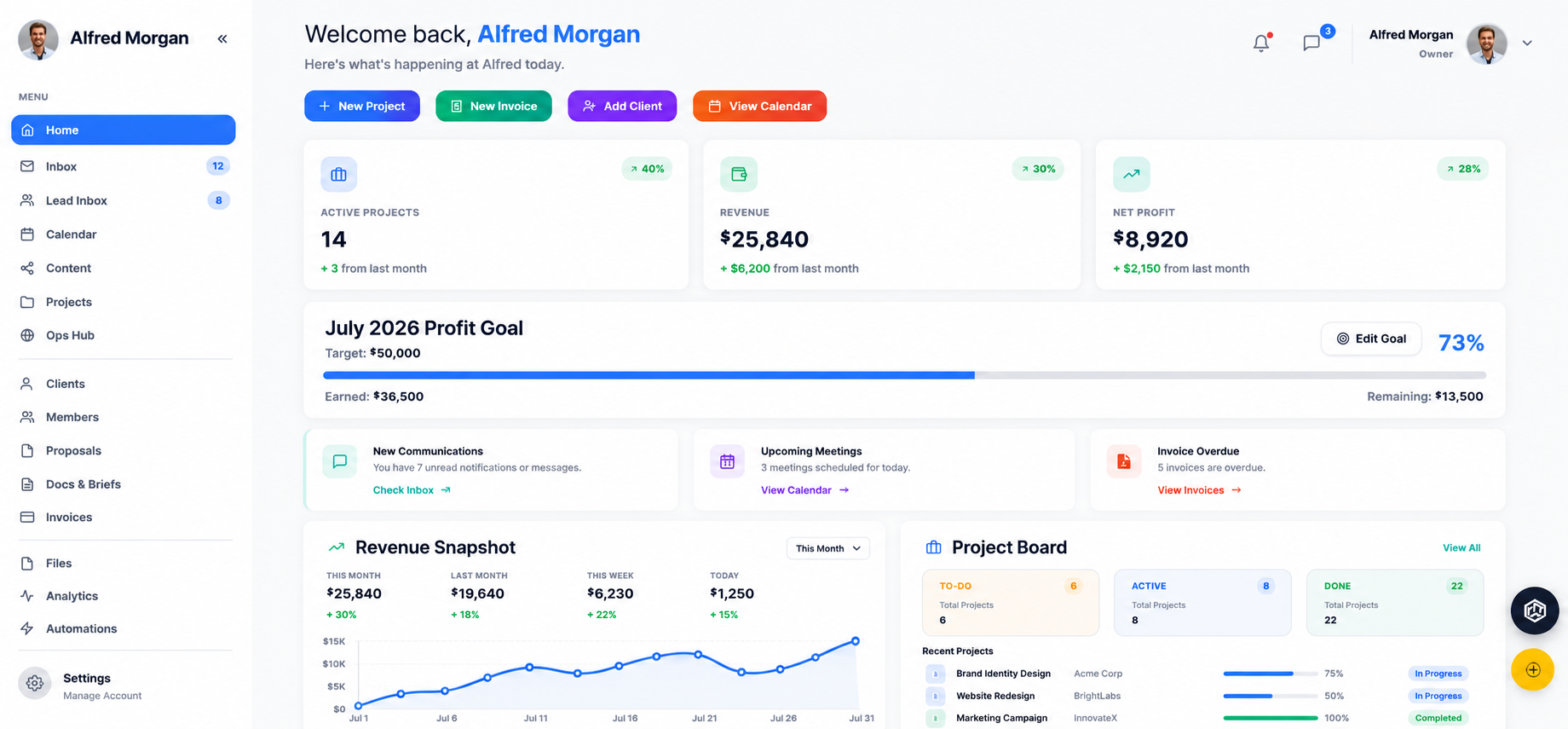
A client CRM joined to proposals, projects and invoices. · Best all-in-one option for small service businesses.Arpixa’s CRM keeps leads, proposals, projects, files and invoices on one client record, which suits small businesses that deliver services. It is lighter on sales and marketing: there are no email sequences, call logging or forecasting, and marketing automation is far behind HubSpot’s.
Strengths
- Client record carries into delivery and billing
- Branded client portal included
- Flat pricing as the team grows
Trade-offs
- No marketing automation or sales sequences
- Free plan limited to one active client a month
Pipedrive
Visual sales pipeline management, boost deals. · Best for sales teams focused on pipeline visualization and deal closing.Pipedrive excels in visual sales pipeline management, making it incredibly intuitive for sales teams to track and move deals forward. Its core strength is its simplicity and focus on sales activities, helping users prioritize and close more effectively. The main trade-off is that its marketing automation and customer service features are less robust than some competitors.
Strengths
- Excellent visual sales pipeline
- Easy to use and set up
- Strong activity tracking features
Trade-offs
- Limited marketing automation
- Basic customer service tools
Freshworks CRM
Unified customer engagement for growing businesses. · Best for growing businesses seeking unified sales and support.Freshworks CRM, formerly Freshsales, offers a unified platform that combines sales and marketing automation with customer support capabilities. Its strong point is the AI-powered insights and lead scoring, helping businesses identify and engage high-potential leads efficiently. A drawback is that some advanced features are locked behind higher-tier plans, increasing costs.
Strengths
- AI-driven lead scoring, insights
- Unified sales, marketing, support
- Intuitive, modern user interface
Trade-offs
- Advanced features cost more
- Reporting customization can be limited
Capsule CRM
Simple, smart CRM for relationship building. · Best for small teams needing straightforward contact management.Capsule CRM provides a straightforward, user-friendly platform focused on contact management and relationship building for small businesses. Its primary strength lies in its simplicity and ease of adoption, making it ideal for teams new to CRM. However, it lacks the extensive marketing automation or advanced reporting found in more comprehensive systems.
Strengths
- Extremely easy to use
- Clean, uncluttered interface
- Good for basic contact management
Trade-offs
- Limited marketing automation
- Basic reporting capabilities
Insightly
CRM with project management capabilities. · Best for small businesses needing CRM with project tracking.Insightly stands out by integrating CRM functionalities with project management features, making it suitable for businesses that manage client-facing projects. Its key benefit is providing a holistic view of customer relationships alongside project progress. The main limitation is that its user interface can sometimes feel less intuitive compared to other modern CRMs.
Strengths
- Integrated project management
- Good for tracking client work
- Strong lead routing capabilities
Trade-offs
- Interface can feel complex
- Higher starting price point
Bitrix24
Free collaborative workspace with CRM included. · Best for teams seeking comprehensive collaboration and CRM.Bitrix24 offers a vast array of tools including CRM, project management, communication, and website building, all within a collaborative workspace. Its main strength is the extensive feature set available even in its free tier, making it a powerful option for budget-conscious teams. The primary trade-off is that its interface can be overwhelming and requires a significant learning investment.
Strengths
- Comprehensive free features
- Includes project management, comms
- Flexible self-hosted option
Trade-offs
- Overwhelming, cluttered interface
- Steep learning curve required
Nutshell
Intuitive CRM for small business sales teams. · Best for sales teams wanting straightforward, user-friendly CRM.Nutshell provides a user-friendly CRM designed specifically for small business sales teams, focusing on ease of use and sales process automation. Its strength lies in its intuitive interface and robust sales reporting, helping teams manage their pipeline effectively. A downside is that its marketing and customer service functionalities are less developed than competitors.
Strengths
- User-friendly interface
- Strong sales reporting features
- Good for sales process automation
Trade-offs
- Limited marketing tools
- Fewer integrations than rivals
Streak
CRM built directly inside Gmail. · Best for Gmail users needing CRM within their inbox.Streak operates as a CRM embedded directly within Gmail, transforming your inbox into a powerful sales and customer management tool. Its greatest advantage is the seamless integration with Gmail and Google Workspace, allowing users to manage contacts and pipelines without leaving their email. The main limitation is its reliance on Gmail, which might not suit businesses needing a standalone CRM or more advanced functionalities.
Strengths
- Seamless Gmail integration
- Easy to set up and use
- Good for managing email pipelines
Trade-offs
- Limited outside Gmail
- Less robust reporting features
Our methodology
Pricing and Value
We evaluate the cost-effectiveness, transparency of pricing tiers, and the features offered at each price point.
Ease of Use and Setup
This criterion assesses how intuitive the interface is, the simplicity of initial setup, and the overall user experience for small business teams.
Core CRM Features
We analyze the robustness of essential CRM functionalities like contact management, lead tracking, sales pipeline, and reporting capabilities.
Security and Support
This looks at data security measures, compliance standards, and the quality and availability of customer support options.
Integrations and Ecosystem
We consider the range of third-party integrations, API availability, and the breadth of the platform's own ecosystem of tools.
Performance and Reliability
This measures the system's speed, stability, uptime, and overall dependability in day-to-day operations for small businesses.
Frequently asked questions
HubSpot is the best CRM for most small businesses: a free CRM with unlimited users, plus marketing and sales tools you can add as you grow. Zoho CRM is the best budget alternative. Arpixa ranks third and suits small businesses that deliver projects for clients.
CRM costs for small businesses vary widely, from free plans with basic features to paid subscriptions ranging from $10 to $50 per user per month. Many top CRMs offer free tiers or trials, allowing businesses to start without significant upfront investment.
Essential features include contact management, lead tracking, sales pipeline visualization, reporting, email integration, and basic automation. Depending on your business, marketing automation, customer service tools, and integrations with other business software might also be crucial.
Yes. HubSpot and Zoho CRM have free plans that suit very small businesses. Arpixa’s free plan is more limited, at one active client a month, and works best as a trial of the full workflow.
Setting up a CRM can range from very easy to moderately complex. Tools like Arpixa, Pipedrive, and Capsule CRM are known for their quick setup and intuitive interfaces, making them ideal for businesses new to CRM. More comprehensive systems might require a steeper learning curve.
CRM focuses on managing customer relationships and sales processes, tracking interactions and deals. Marketing automation, while often integrated with CRM, specifically handles automated marketing tasks like email campaigns, lead nurturing, and social media posting to attract and engage leads.
CRM helps small businesses grow by centralizing customer data, improving sales efficiency, enhancing customer service, and enabling targeted marketing efforts. It provides insights into customer behavior, allowing for better decision-making and stronger client relationships.
For most small businesses an all-in-one tool is simpler and often cheaper. HubSpot covers sales, marketing and service; Arpixa covers sales, delivery and billing for service businesses. Specialised tools suit businesses with advanced needs in one area.
Cloud-based CRMs offer numerous benefits for small businesses, including lower upfront costs, remote accessibility, automatic updates, scalability, and enhanced data security. They eliminate the need for in-house IT infrastructure and maintenance.
Integrations are very important for a small business CRM as they allow it to connect with other essential tools like email marketing software, accounting platforms, and communication apps. This creates a unified workflow, reduces manual data entry, and improves overall efficiency.
Run your business on Arpixa
CRM, proposals, projects, client portal, invoicing and payments in one AI-native workspace with flat pricing.