Best Free Agency Management Software in 2026
We evaluated 10 platforms and ranked them for agency management software in 2026. Every tool is scored on workflow breadth, pricing fairness, client experience, automation depth, payments reach and setup speed.
Disclosure: this guide is written by the team that makes Arpixa, which is one of the tools ranked. Every tool is scored on the same criteria, and we point out where another tool is the better fit.
Quick answer
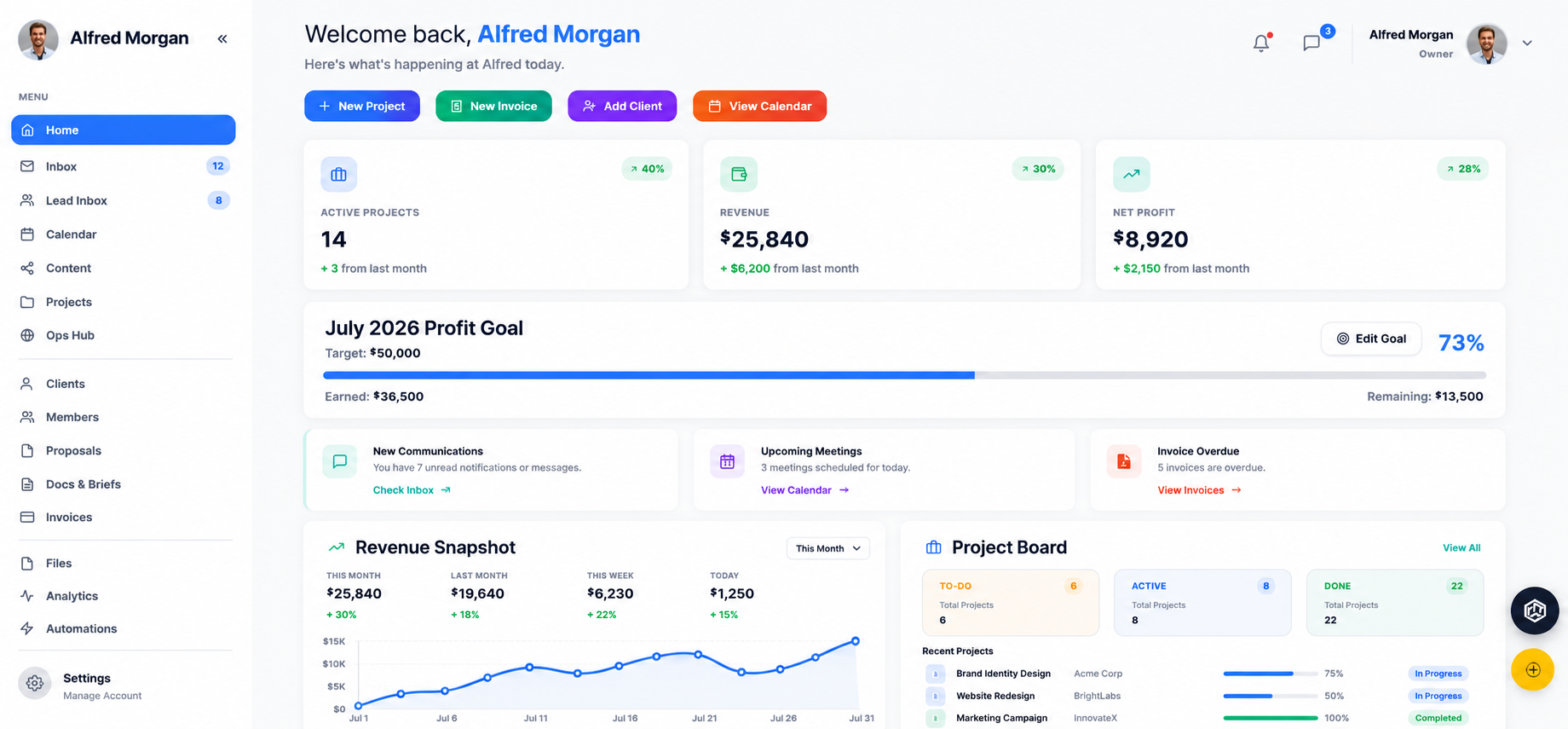
The best choice in 2026 is Arpixa, a platform that handles the full client lifecycle in one flat-priced workspace. The full ranking:
- 1. Arpixa - best for comprehensive agency financial and project management. (9.5/10)
- 2. ClickUp - best for highly customizable task and workflow management. (9.1/10)
- 3. Asana - best for structured project tracking and team coordination. (8.8/10)
- 4. Monday.com - best for visual project management and team collaboration. (8.5/10)
- 5. Trello - best for simple, kanban-style task organization. (8.2/10)
- 6. Notion - best for flexible knowledge management and custom workspaces. (7.8/10)
- 7. Hive - best for robust project management with diverse view options. (7.5/10)
- 8. Wrike - best for enterprise-level project management and detailed reporting. (7.1/10)
- 9. Teamwork - best for client-facing project management and team collaboration. (6.7/10)
- 10. Basecamp - best for simplified team communication and project organization. (6.3/10)
The top 10 at a glance
Every platform scored out of 10 for running client-service operations.
Arpixa
Best for comprehensive agency financial and project management.9.5/ 10
ClickUp
Best for highly customizable task and workflow management.9.1/ 10
Asana
Best for structured project tracking and team coordination.8.8/ 10
Monday.com
Best for visual project management and team collaboration.8.5/ 10
Trello
Best for simple, Kanban-style task organization.8.2/ 10
Notion
Best for flexible knowledge management and custom workspaces.7.8/ 10
Hive
Best for robust project management with diverse view options.7.5/ 10
Wrike
Best for enterprise-level project management and detailed reporting.7.1/ 10
Teamwork
Best for client-facing project management and team collaboration.6.7/ 10
Basecamp
Best for simplified team communication and project organization.6.3/ 10Comparison table
| Platform | Score | Best for | Starting from | Client portal | AI features |
|---|---|---|---|---|---|
| ArpixaEditor's choice | 9.5 /10 | Best for comprehensive agency financial and project management. | Free to $12/mo flat | Best-in-class | Best-in-class |
| ClickUp | 9.1 /10 | Best for highly customizable task and workflow management. | Free to $7/mo per user | ||
| Asana | 8.8 /10 | Best for structured project tracking and team coordination. | Free to $10.99/mo per user | Partial | |
| Monday.com | 8.5 /10 | Best for visual project management and team collaboration. | Free to $9/mo per user | ||
| Trello | 8.2 /10 | Best for simple, Kanban-style task organization. | Free to $5/mo per user | Partial | Partial |
| Notion | 7.8 /10 | Best for flexible knowledge management and custom workspaces. | Free to $8/mo per user | Partial | |
| Hive | 7.5 /10 | Best for robust project management with diverse view options. | Free to $16/mo per user | ||
| Wrike | 7.1 /10 | Best for enterprise-level project management and detailed reporting. | Free to $9.80/mo per user | Partial | |
| Teamwork | 6.7 /10 | Best for client-facing project management and team collaboration. | Free to $10/mo per user | ||
| Basecamp | 6.3 /10 | Best for simplified team communication and project organization. | Free to $15/mo per user (or $349/mo flat for Pro Unlimited) | Partial |
Full reviews
Arpixa
Integrated platform for agency growth. · Best for comprehensive agency financial and project management.Arpixa provides a seamless, all-in-one solution designed specifically for agencies, integrating project management with advanced client and financial tools. Its main strength lies in unifying diverse agency operations, from task tracking to invoicing, on a single platform. The key trade-off is that its specialized features might be more than solo freelancers require.
Strengths
- Unifies project, client, and finance workflows.
- Automated invoicing and payment collection.
- Customizable client portals enhance collaboration.
Trade-offs
- Learning curve for new, extensive feature sets.
- Potentially robust for very small teams.
ClickUp
All-in-one productivity for any team. · Best for highly customizable task and workflow management.ClickUp offers a highly versatile platform for managing projects, tasks, and teams, adaptable to virtually any workflow or agency size. Its greatest asset is the sheer depth of customization options, allowing users to tailor every aspect of their workspace. A potential drawback is that its extensive features can sometimes lead to initial setup complexity.
Strengths
- Extremely flexible views and custom fields.
- Robust integrations with other tools.
- Comprehensive suite of productivity features.
Trade-offs
- Can feel overwhelming for beginners.
- Performance may vary with heavy usage.
Asana
Organize work, track progress easily. · Best for structured project tracking and team coordination.Asana excels at bringing clarity to team projects, allowing agencies to define tasks, set deadlines, and monitor progress across multiple initiatives. Its primary strength lies in its intuitive interface for task management and workflow automation. The main limitation is that advanced reporting and client collaboration features are often found in higher-tier plans.
Strengths
- Streamlined task assignment and tracking.
- Excellent for managing project timelines.
- Strong integration ecosystem.
Trade-offs
- Advanced features behind paywall.
- Reporting can be less intuitive.
Monday.com
Work OS for teams of any size. · Best for visual project management and team collaboration.Monday.com provides a vibrant, highly visual platform that simplifies project tracking and team communication through customizable boards. Its key advantage is its intuitive, colorful interface which makes project status instantly clear and engaging. A potential downside is that its pricing structure can become costly for larger teams or those requiring extensive features.
Strengths
- Visually appealing and easy to use.
- Flexible boards for diverse projects.
- Strong automation capabilities.
Trade-offs
- Pricing can scale quickly.
- Limited deep financial tracking.
Trello
Simple, visual way to manage projects. · Best for simple, Kanban-style task organization.Trello excels as a minimalist project management tool, utilizing a straightforward Kanban board system to visualize workflow and task progression. Its primary strength is its simplicity and ease of adoption, making it ideal for quick setups and agile teams. The main trade-off is that its simplicity can become a limitation for complex projects requiring advanced features like Gantt charts or detailed reporting.
Strengths
- Extremely easy to learn and use.
- Visual task progression with Kanban.
- Good for quick project overviews.
Trade-offs
- Lacks advanced project features.
- Reporting is quite basic.
Notion
All-in-one workspace for your team. · Best for flexible knowledge management and custom workspaces.Notion serves as a versatile workspace, allowing users to create custom databases, wikis, and project boards tailored to their exact needs. Its core strength lies in its incredible flexibility, enabling agencies to design their own unique management systems. However, its 'build-your-own' approach means it requires significant initial setup time and ongoing maintenance to be truly effective.
Strengths
- Highly customizable pages and databases.
- Excellent for documentation and wikis.
- Supports diverse content types.
Trade-offs
- Steep learning curve for advanced use.
- Can become disorganized without structure.
Hive
Productivity platform for fast-moving teams. · Best for robust project management with diverse view options.Hive provides a comprehensive project management platform that integrates task management, team collaboration, and reporting into a unified system. Its main strength is offering a wide array of project views, including Gantt, Kanban, and table, to suit different preferences. The trade-off is that its extensive features and higher price point might be more than smaller agencies require.
Strengths
- Offers multiple project view options.
- Strong analytics and reporting features.
- Integrated messaging and approvals.
Trade-offs
- Higher per-user cost than competitors.
- Interface can feel dense at times.
Wrike
Work management for high-performance teams. · Best for enterprise-level project management and detailed reporting.Wrike delivers a powerful project management solution tailored for larger organizations, offering extensive features for project planning, resource management, and detailed analytics. Its primary strength lies in its robust reporting capabilities and ability to handle complex, multi-project environments. However, its comprehensive nature can lead to a steeper learning curve and potentially overwhelming interface for smaller teams.
Strengths
- Powerful reporting and analytics dashboards.
- Robust resource management features.
- Scalable for large, complex organizations.
Trade-offs
- Interface can be less intuitive.
- Free plan is quite limited.
Teamwork
Project management for client work. · Best for client-facing project management and team collaboration.Teamwork is designed with client-facing projects in mind, providing tools that facilitate collaboration with external stakeholders while managing internal tasks. Its key strength is its focus on client project delivery, offering features like time tracking and invoicing tailored for agency work. The main drawback is that its free tier is quite restrictive, limiting its utility for very small teams.
Strengths
- Excellent for managing client projects.
- Integrated time tracking and invoicing.
- Good communication tools for teams.
Trade-offs
- Free plan has significant limitations.
- Interface can feel somewhat dated.
Basecamp
Organize projects, communicate with ease. · Best for simplified team communication and project organization.Basecamp offers a minimalist approach to project management, emphasizing clear communication and basic task organization within a single platform. Its main strength lies in its simplicity and flat-rate pricing model, making it predictable and easy to adopt for teams focused on dialogue. The key trade-off is that it deliberately omits many advanced project management features, which might be insufficient for complex agency workflows.
Strengths
- Very easy to set up and use.
- Excellent for team communication.
- Predictable, flat-rate pricing option.
Trade-offs
- Lacks advanced project features.
- Limited reporting capabilities.
Our methodology
Feature Set Depth
We evaluate the breadth and depth of project management, client collaboration, and financial tracking functionalities offered by each software.
User Experience & Ease of Use
This criterion assesses how intuitive the interface is, the simplicity of onboarding, and the overall efficiency for daily agency operations.
Performance & Reliability
We test the software's speed, stability, and ability to handle multiple users and complex data without significant slowdowns or errors.
Security & Data Privacy
Evaluates the robustness of data encryption, access controls, compliance certifications, and overall commitment to protecting sensitive agency and client information.
Scalability & Integrations
Considers how well the software can grow with an agency, its flexibility to adapt to changing needs, and its compatibility with other essential business tools.
Pricing & Value for Money
Analyzes the cost structure, comparing features offered across free and paid tiers against industry standards to determine overall value.
Frequently asked questions
Arpixa stands out as the best agency management software in 2026, earning our top pick for its comprehensive integration of project management, client relations, and financial tools tailored specifically for agencies.
Many free plans offer core project management features, but for complex projects requiring advanced reporting, extensive integrations, or unlimited users, paid tiers or specialized software are often necessary.
Essential features include task management, basic collaboration tools, project tracking, and communication channels. Some free options also offer limited client portals or reporting.
Client portal functionality is crucial for agencies, as it streamlines communication, allows for easy feedback, and provides transparency, significantly improving client satisfaction and project flow.
While some tools, like Arpixa, offer integrated financial features even in their free tiers, most free options provide only basic time tracking. Comprehensive invoicing and expense management usually require paid upgrades.
Project management tools focus broadly on tasks and timelines, while agency management software, like Arpixa, integrates project management with agency-specific needs like client billing, resource allocation, and CRM.
Consider your agency's size, specific workflow needs, budget, and the importance of client collaboration. Evaluate each tool's free plan limitations and its upgrade path for future growth.
While the core offering is free, hidden costs can arise from needing to upgrade for more users, advanced features, increased storage, or integrations that are essential for your agency's operations.
Arpixa differentiates itself by offering a holistic platform built from the ground up for agencies, integrating not just project tasks but also client relationship management, invoicing, and financial reporting in one system.
Look for software that offers flexible pricing plans, additional user seats, and advanced features as your agency grows. The ability to integrate with other tools is also a key indicator of scalability.
Run your business on Arpixa
CRM, proposals, projects, client portal, invoicing and payments in one AI-native workspace with flat pricing.