Best Free Team Collaboration Software in 2026
We evaluated 10 platforms and ranked them for team collaboration software in 2026. Every tool is scored on workflow breadth, pricing fairness, client experience, automation depth, payments reach and setup speed.
Disclosure: this guide is written by the team that makes Arpixa, which is one of the tools ranked. Every tool is scored on the same criteria, and we point out where another tool is the better fit.
Quick answer
The best choice in 2026 is Slack, best for real-time team communication and external collaboration. Arpixa ranks #5 as the all-in-one option for client work. The full ranking:
- 1. Slack - best for real-time team communication and external collaboration. (8.7/10)
- 2. Microsoft Teams - best for organizations deeply integrated into the microsoft 365 ecosystem. (8.3/10)
- 3. Zoom - best for reliable video conferencing and virtual meetings. (7.9/10)
- 4. Notion - best for flexible workspace creation, knowledge bases, and project tracking. (7.5/10)
- 5. Arpixa - best all-in-one option for collaborating with clients. (7.3/10)
- 6. Trello - best for visual task management using kanban boards. (7.1/10)
- 7. ClickUp - best for highly customizable project management across various methodologies. (6.7/10)
- 8. Flock - best for small teams seeking a straightforward communication platform. (6.3/10)
- 9. Chanty - best for teams needing unlimited message history on a free plan. (5.9/10)
- 10. Spike - best for email-centric teams wanting a conversational inbox. (5.6/10)
The top 10 at a glance
Every platform scored out of 10 for running client-service operations.

Slack
Best for real-time team communication and external collaboration.8.7/ 10
Microsoft Teams
Best for organizations deeply integrated into the Microsoft 365 ecosystem.8.3/ 10
Zoom
Best for reliable video conferencing and virtual meetings.7.9/ 10
Notion
Best for flexible workspace creation, knowledge bases, and project tracking.7.5/ 10
Arpixa
Best all-in-one option for collaborating with clients.7.3/ 10
Trello
Best for visual task management using Kanban boards.7.1/ 10
ClickUp
Best for highly customizable project management across various methodologies.6.7/ 10
Flock
Best for small teams seeking a straightforward communication platform.6.3/ 10
Chanty
Best for teams needing unlimited message history on a free plan.5.9/ 10
Spike
Best for email-centric teams wanting a conversational inbox.5.6/ 10Comparison table
| Platform | Score | Best for | Starting from | Video calls | File sharing |
|---|---|---|---|---|---|
| SlackEditor's choice | 8.7 /10 | Best for real-time team communication and external collaboration. | Free plan, from $7.25/user/mo | Best-in-class | |
| Microsoft Teams | 8.3 /10 | Best for organizations deeply integrated into the Microsoft 365 ecosystem. | Free plan, from $4/user/mo | Best-in-class | |
| Zoom | 7.9 /10 | Best for reliable video conferencing and virtual meetings. | Free plan, from $149.90/year/user | Best-in-class | Partial |
| Notion | 7.5 /10 | Best for flexible workspace creation, knowledge bases, and project tracking. | Free plan, from $8/user/mo | ||
| Arpixa | 7.3 /10 | Best all-in-one option for collaborating with clients. | Free plan, from $12/mo flat | Partial | |
| Trello | 7.1 /10 | Best for visual task management using Kanban boards. | Free plan, from $5/user/mo | Partial | |
| ClickUp | 6.7 /10 | Best for highly customizable project management across various methodologies. | Free plan, from $7/user/mo | ||
| Flock | 6.3 /10 | Best for small teams seeking a straightforward communication platform. | Free plan, from $4.50/user/mo | Partial | |
| Chanty | 5.9 /10 | Best for teams needing unlimited message history on a free plan. | Free plan, from $3/user/mo | Partial | |
| Spike | 5.6 /10 | Best for email-centric teams wanting a conversational inbox. | Free plan, from $5/user/mo | Partial |
Full reviews
Slack
Instant messaging for productive team conversations. · Best for real-time team communication and external collaboration.Slack is a leading messaging platform designed to facilitate rapid, organized communication through channels and direct messages. Its strength is its extensive integration ecosystem and intuitive interface for quick chats, but its free tier significantly limits message history access.
Strengths
- Excellent for real-time group and private chat.
- Vast app directory for third-party integrations.
- Intuitive interface, easy for new users to adopt.
Trade-offs
- Free plan restricts searchable message history.
- Video conferencing features are somewhat basic.
Microsoft Teams
Connect, collaborate, and create with Microsoft. · Best for organizations deeply integrated into the Microsoft 365 ecosystem.Microsoft Teams serves as a hub for teamwork, combining chat, video meetings, file storage, and application integration, especially within the Microsoft environment. Its main advantage is its deep integration with Office 365 apps, though its interface can feel less streamlined compared to dedicated chat apps.
Strengths
- Seamlessly integrates with Word, Excel, PowerPoint.
- Robust video conferencing and screen sharing.
- Strong security and compliance features for enterprises.
Trade-offs
- Can feel resource-intensive on older computers.
- Interface sometimes appears cluttered for new users.
Zoom
Leading video communication for seamless connections. · Best for reliable video conferencing and virtual meetings.Zoom is primarily a video conferencing solution known for its stability and ease of use in hosting virtual meetings and webinars. Its core strength lies in its superior video and audio quality, but its free version imposes strict time limits on group meetings.
Strengths
- Exceptional video and audio clarity for calls.
- Easy to schedule and join meetings quickly.
- Breakout rooms enhance interactive sessions.
Trade-offs
- Free group meetings limited to 40 minutes.
- Lacks comprehensive project management features.
Notion
All-in-one workspace for notes, tasks, wikis. · Best for flexible workspace creation, knowledge bases, and project tracking.Notion provides a versatile workspace combining notes, databases, wikis, and project management into a single, highly customizable platform. Its strength is its incredible flexibility and ability to adapt to almost any workflow, though its open-ended nature can be overwhelming for users preferring structured tools.
Strengths
- Extremely adaptable for various team needs.
- Powerful database functionality for tracking.
- Excellent for building shared knowledge bases.
Trade-offs
- Steep learning curve due to extensive customization.
- Offline access is limited in some versions.
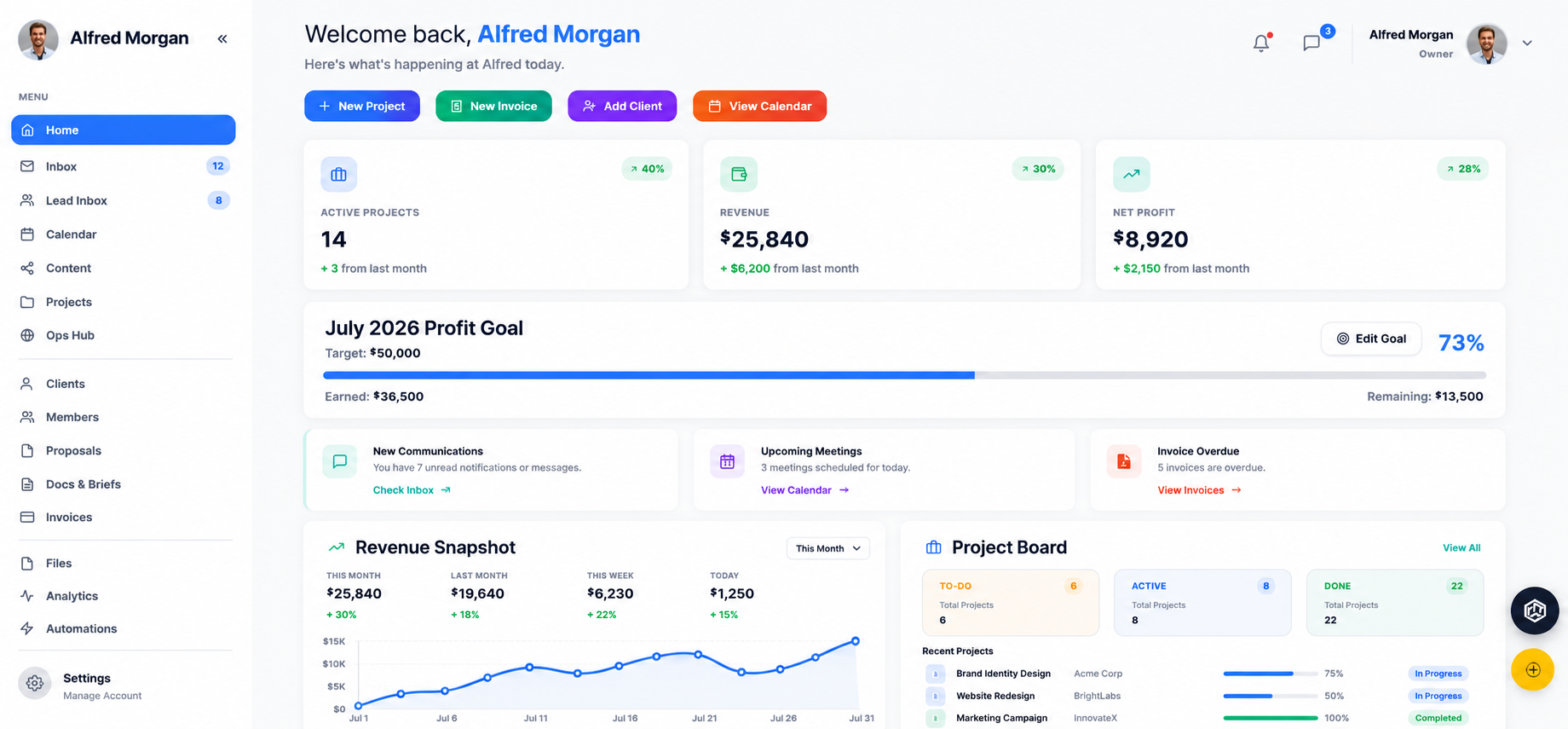
Arpixa
Client collaboration in a branded portal. · Best all-in-one option for collaborating with clients.Arpixa is built for collaborating with clients: they see projects, deliverables, files and invoices in a branded portal and message the team by topic. It is not a chat or video app, so most teams keep Slack, Teams or Zoom for internal conversation. The free plan covers one active client a month, so it suits trying the workflow more than running a business on it.
Strengths
- Client approvals and messages in one portal
- Files and decisions kept with the project
- Google Meet links on client meetings
Trade-offs
- No real-time team chat or video calls
- Limited free plan
Trello
Simple, visual project management with boards. · Best for visual task management using Kanban boards.Trello utilizes a Kanban-style board system for project and task management, offering a simple, visual way to organize work. Its strength lies in its intuitive drag-and-drop interface and clear task progression, but its free plan offers limited automation and integration capabilities.
Strengths
- Highly visual and easy to understand task flow.
- Simple drag-and-drop interface for task updates.
- Effective for managing small to medium projects.
Trade-offs
- Limited reporting and analytics on free plan.
- Not ideal for complex, multi-layered projects.
ClickUp
One app to replace them all. · Best for highly customizable project management across various methodologies.ClickUp is an all-in-one productivity platform offering extensive customization for project management, task tracking, and collaboration. Its strength is its unparalleled flexibility with multiple views and features, although this breadth of options can sometimes lead to an overwhelming user experience.
Strengths
- Offers numerous project views, including Gantt, Kanban.
- Highly customizable tasks, statuses, and workflows.
- Extensive features cover many productivity needs.
Trade-offs
- Interface can feel complex and overwhelming initially.
- Some advanced features are only in paid tiers.
Flock
Faster communication, better productivity. · Best for small teams seeking a straightforward communication platform.Flock provides a team communication and collaboration app with features like messaging, video calls, and integrated productivity tools. Its primary strength lies in its simplicity and ease of use, offering a clean interface, but its free tier has significant limitations on message history and storage.
Strengths
- User-friendly interface for quick adoption.
- Built-in to-do lists and polls are convenient.
- Affordable pricing for paid plans.
Trade-offs
- Free plan limits message history to 10k.
- Integrations are not as extensive as competitors.
Chanty
Simple team chat with unlimited history. · Best for teams needing unlimited message history on a free plan.Chanty is a team collaboration tool focused on chat, offering unlimited message history even on its free plan, alongside task management and voice/video calls. Its key advantage is the generous free message history, though its range of integrations and advanced features is more limited than rivals.
Strengths
- Unlimited searchable message history, even free.
- Integrated task management within conversations.
- Affordable paid plans for growing teams.
Trade-offs
- Fewer third-party integrations compared to Slack.
- Video call quality can sometimes be inconsistent.
Spike
Your inbox, reimagined for teamwork. · Best for email-centric teams wanting a conversational inbox.Spike transforms your email into a chat-like conversation hub, integrating communication, notes, and tasks within an email-first interface. Its main strength is its unique approach to making email more conversational and collaborative, but it might not suit teams that prefer dedicated project management tools.
Strengths
- Transforms emails into chat-like conversations.
- Integrated notes, tasks, and calendar features.
- Reduces inbox clutter effectively.
Trade-offs
- Less suitable for traditional project tracking.
- Reliance on email might not fit all workflows.
Our methodology
Pricing Models
We evaluate the transparency and value of free tiers and paid plans, considering user limits and feature access.
User Experience
We assess ease of use, interface intuitiveness, and the learning curve for new team members.
Core Functionality
We scrutinize the primary features like communication, task management, and file sharing capabilities.
Security and Privacy
We examine data encryption, compliance standards, and user privacy policies to ensure safe collaboration.
Integration Ecosystem
We analyze the breadth and depth of third-party integrations, crucial for connecting existing workflows.
Performance and Reliability
We test for speed, uptime consistency, and overall system stability during peak usage.
Frequently asked questions
Slack is the best free collaboration tool for most teams: fast chat, huddles and many integrations, with a free plan that keeps recent history. Microsoft Teams is the better free choice for Microsoft users. Arpixa ranks fifth and is aimed at collaborating with clients rather than internal chat.
Free collaboration tools often operate on a freemium model, offering basic features for free and charging for advanced functionalities, increased storage, or more users.
Free plans typically limit features like message history, storage space, advanced integrations, user count, or specific premium functionalities such as advanced analytics or custom branding.
While some free tools accommodate larger groups, their limitations on users, storage, or history often make them more suitable for small to medium-sized teams or specific project needs.
Reputable free platforms generally employ standard security measures like encryption, but users should always review specific privacy policies and terms of service.
Key features include real-time messaging, file sharing, task management, video conferencing, and the ability to integrate with other essential business applications.
Integrations are crucial for connecting your collaboration tool with other software your team uses, such as CRM, project management, or code repositories, streamlining workflows.
Many free collaboration tools aim to reduce internal email traffic by centralizing discussions, file sharing, and project updates into a more dynamic, chat-based environment.
Project management tools focus on organizing tasks, timelines, and resources, while communication tools prioritize instant messaging, video calls, and group discussions. Many tools now combine both.
While the core offering is free, potential hidden costs might include needing to upgrade for essential features, exceeding storage limits, or requiring paid integrations to function effectively.
Run your business on Arpixa
CRM, proposals, projects, client portal, invoicing and payments in one AI-native workspace with flat pricing.