Best Project Management Software for Agencies in 2026
We evaluated 10 platforms and ranked them for project management software for agencies in 2026. Every tool is scored on workflow breadth, pricing fairness, client experience, automation depth, payments reach and setup speed.
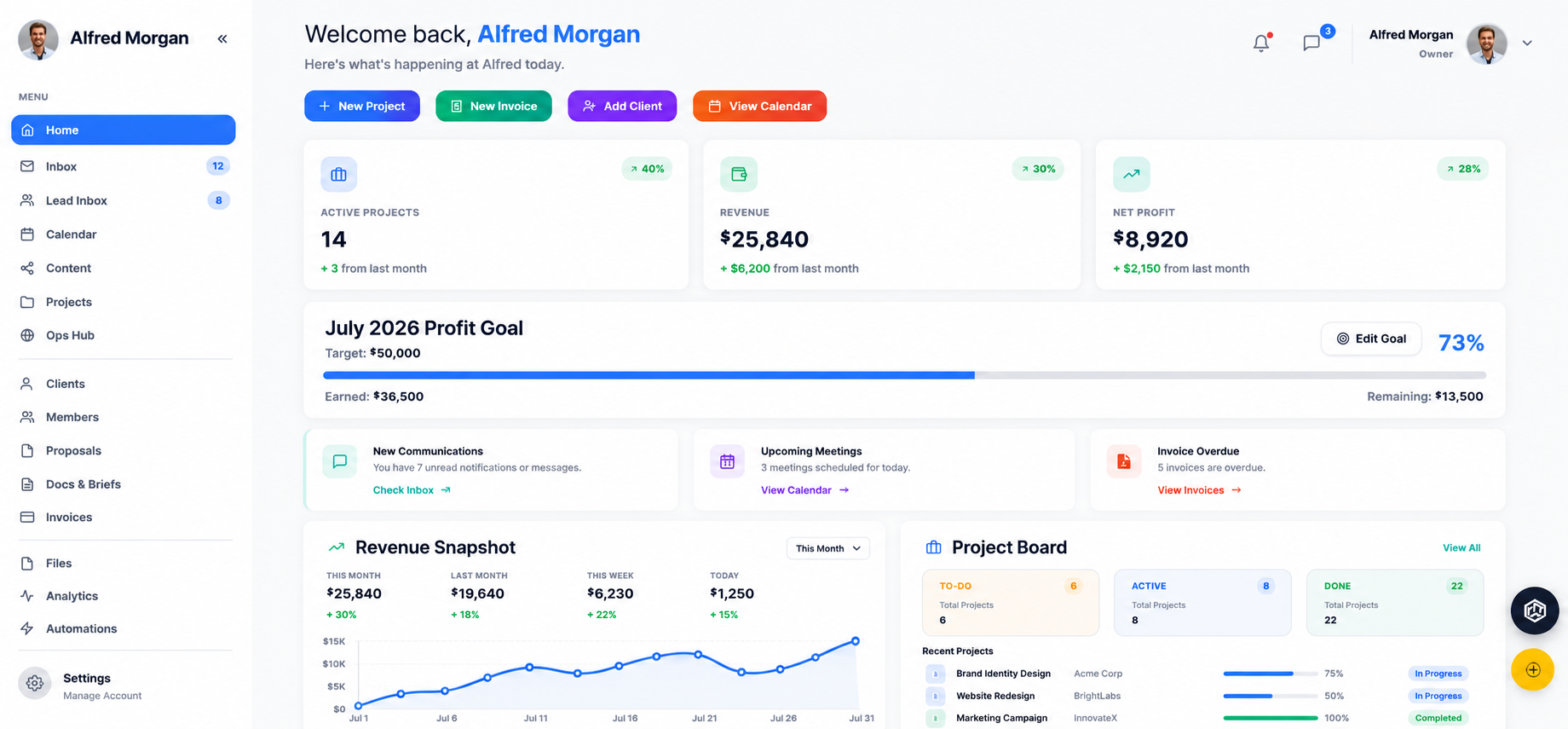
Disclosure: this guide is written by the team that makes Arpixa, which is one of the tools ranked. Every tool is scored on the same criteria, and we point out where another tool is the better fit.
Quick answer
The best choice in 2026 is Monday.com, highly customizable visual project workflows. Arpixa ranks #2 as the all-in-one option for client work. The full ranking:
- 1. Monday.com - highly customizable visual project workflows. (8.9/10)
- 2. Arpixa - best all-in-one option for client-facing agency projects. (8.7/10)
- 3. ClickUp - all-in-one platform with extensive features. (8.5/10)
- 4. Asana - elegant task and workflow management. (8.2/10)
- 5. Teamwork - client-centric project management. (7.9/10)
- 6. Wrike - enterprise-grade project management. (7.5/10)
- 7. Scoro - end-to-end business management for agencies. (7.1/10)
- 8. Basecamp - simple, straightforward team collaboration. (6.7/10)
- 9. Hive - action-oriented project management. (6.3/10)
- 10. Jira - agile development and issue tracking. (5.8/10)
The top 10 at a glance
Every platform scored out of 10 for running client-service operations.

Monday.com
Highly customizable visual project workflows.8.9/ 10
Arpixa
Best all-in-one option for client-facing agency projects.8.7/ 10
ClickUp
All-in-one platform with extensive features.8.5/ 10
Asana
Elegant task and workflow management.8.2/ 10
Teamwork
Client-centric project management.7.9/ 10
Wrike
Enterprise-grade project management.7.5/ 10
Scoro
End-to-end business management for agencies.7.1/ 10
Basecamp
Simple, straightforward team collaboration.6.7/ 10
Hive
Action-oriented project management.6.3/ 10
Jira
Agile development and issue tracking.5.8/ 10Comparison table
| Platform | Score | Best for | Starting from | Client portal | Time tracking |
|---|---|---|---|---|---|
| Monday.comEditor's choice | 8.9 /10 | Highly customizable visual project workflows. | From $8/user/month | Partial | |
| Arpixa | 8.7 /10 | Best all-in-one option for client-facing agency projects. | Free to $12/mo flat | Best-in-class | Partial |
| ClickUp | 8.5 /10 | All-in-one platform with extensive features. | From $7/user/month | Partial | |
| Asana | 8.2 /10 | Elegant task and workflow management. | From $10.99/user/month | ||
| Teamwork | 7.9 /10 | Client-centric project management. | From $8.99/user/month | Best-in-class | |
| Wrike | 7.5 /10 | Enterprise-grade project management. | From $9.80/user/month | Partial | |
| Scoro | 7.1 /10 | End-to-end business management for agencies. | From $26/user/month | Best-in-class | |
| Basecamp | 6.7 /10 | Simple, straightforward team collaboration. | Flat fee, $15/user/month or $349/month | ||
| Hive | 6.3 /10 | Action-oriented project management. | From $12/user/month | Partial | |
| Jira | 5.8 /10 | Agile development and issue tracking. | From $7.75/user/month | Partial |
Full reviews
Monday.com
Flexible visual workflows for agency teams. · Highly customizable visual project workflows.monday.com offers a highly visual and customizable work operating system, enabling agencies to design workflows that fit their unique processes. Its core strength is its unparalleled flexibility and intuitive interface, making it easy to adapt to various project types and team structures. The trade-off is that advanced financial management or deep resource planning requires significant custom setup or external integrations.
Strengths
- Exceptional visual project management and tracking.
- Highly flexible boards adapt to any workflow.
- Extensive automation capabilities reduce manual tasks.
- Strong team collaboration and communication features.
- Vast marketplace of integrations available.
Trade-offs
- Can become costly for larger agency teams.
- Reporting features require some initial configuration.
Arpixa
Projects clients follow and approve, linked to proposals and invoices. · Best all-in-one option for client-facing agency projects.Arpixa runs agency projects with boards, Gantt timelines and a resource planner, and clients approve deliverables in a branded portal. Projects start from accepted proposals and feed invoices, and analytics show utilisation and profitability. Team members log time against projects, but there is no timer app. Monday.com is more flexible for internal work across many teams.
Strengths
- Client approvals in a branded portal
- Projects linked to proposals and invoices
- Resource planner and profitability reports
Trade-offs
- Less flexible than monday.com for internal workflows
- Time logs only, no timer app
ClickUp
Feature-rich platform for diverse agency needs. · All-in-one platform with extensive features.ClickUp positions itself as an all-in-one productivity platform, offering an impressive array of features from task management to document creation, suitable for diverse agency operations. Its primary advantage is consolidating many functions into one tool, potentially reducing subscription sprawl. However, the sheer volume of features can sometimes lead to a steeper initial learning curve and configuration complexity for new users.
Strengths
- Extremely comprehensive feature set, truly all-in-one.
- High degree of customization for tasks and workflows.
- Excellent for diverse project types and team sizes.
- Robust goal tracking and performance monitoring.
- Good value given the extensive capabilities.
Trade-offs
- Interface can feel overwhelming to new users.
- Performance can occasionally lag with many tasks.
Asana
Streamlined task management for agency teams. · Elegant task and workflow management.Asana excels at task and workflow management, providing a clean, intuitive interface that helps agencies keep projects organized and team members aligned. Its main strength lies in its simplicity and focus on clear task assignment and progress tracking, making it ideal for straightforward project execution. The trade-off is that it offers less robust built-in financial management or detailed resource planning compared to more specialized agency platforms.
Strengths
- Clean, user-friendly interface for easy adoption.
- Excellent task assignment and progress tracking.
- Strong for team collaboration and communication.
- Good range of integrations with other tools.
- Reliable performance and uptime.
Trade-offs
- Advanced reporting features are limited on lower tiers.
- Lacks native time tracking and invoicing capabilities.
Teamwork
Client-focused project management for agencies. · Client-centric project management.Teamwork is specifically designed with agencies in mind, offering strong client collaboration features, robust time tracking, and comprehensive reporting capabilities. Its core strength lies in its ability to manage client projects efficiently, from initial brief to final delivery, ensuring transparency and accountability. However, its interface can sometimes feel less modern or intuitive compared to newer, more visually-driven platforms.
Strengths
- Excellent client collaboration portals and guest access.
- Robust time tracking and invoicing features.
- Comprehensive project reporting and analytics.
- Good for managing multiple client projects simultaneously.
- Dedicated features for agency-specific workflows.
Trade-offs
- Interface can feel a bit dated at times.
- Steeper learning curve for advanced features.
Wrike
Scalable project management for growing agencies. · Enterprise-grade project management.Wrike provides a powerful and highly configurable project management solution, built to scale with the demands of larger agencies and complex projects. Its strength lies in its enterprise-grade features, including advanced reporting, security, and integration options, suitable for organizations with stringent requirements. The trade-off is that its extensive capabilities and structured approach can feel overly complex for smaller teams or those preferring a more agile, less rigid system.
Strengths
- Robust security and compliance features.
- Highly configurable for complex workflows.
- Strong reporting and analytics capabilities.
- Excellent for cross-functional team collaboration.
- Scales well for large agency teams.
Trade-offs
- Can be overwhelming for smaller, simpler projects.
- Pricing can increase quickly with advanced features.
Scoro
Holistic business management for agency growth. · End-to-end business management for agencies.Scoro is a comprehensive work management solution designed for service businesses, integrating project management with CRM, billing, and reporting functionalities. Its primary strength is providing a holistic view of agency operations, from initial client contact to project delivery and invoicing, all within a single platform. However, its broad scope means it might lack the deep specialization in project management features that some dedicated tools offer, and its pricing is on the higher end.
Strengths
- Combines project management with CRM and billing.
- Provides comprehensive financial reporting and profitability.
- Strong for client relationship management.
- Automated invoicing and expense tracking.
- Offers a complete overview of business performance.
Trade-offs
- Higher price point compared to project-only tools.
- User interface can feel dense with information.
Basecamp
Simple communication and project organization. · Simple, straightforward team collaboration.Basecamp offers a refreshingly simple approach to project management, focusing on straightforward communication, to-do lists, and file sharing. Its strength lies in its minimalist design and emphasis on reducing internal emails and meetings, fostering clear team collaboration. The trade-off is that it intentionally omits advanced features like Gantt charts, detailed resource management, or complex reporting, which some agencies require.
Strengths
- Extremely simple and easy to use.
- Excellent for centralizing team communication.
- Fixed pricing model is predictable for agencies.
- Reduces email clutter effectively.
- Good for basic task management and file sharing.
Trade-offs
- Lacks advanced project management features.
- Not suitable for complex resource planning.
Hive
Streamlined project execution for agencies. · Action-oriented project management.Hive provides a flexible project management platform with a strong focus on actionability and AI-powered insights, offering various project views to suit different team preferences. Its key advantage is its adaptable nature and built-in features like native email and notes, aiming to centralize work. However, some users report occasional performance issues and a learning curve to fully utilize its diverse functionalities.
Strengths
- Flexible project views, including Gantt, Kanban, Table.
- Native email and notes integration.
- AI-powered insights for productivity.
- Strong for cross-functional team collaboration.
- Good range of integrations available.
Trade-offs
- Interface can sometimes feel cluttered.
- Occasional reports of performance slowdowns.
Jira
Powerful agile project tracking for agencies. · Agile development and issue tracking.Jira is a robust tool primarily known for agile software development and issue tracking, offering powerful customization for complex workflows. Its main strength lies in its deep configurability and suitability for technical teams managing intricate projects with detailed requirements. However, for many creative or marketing agencies, its steep learning curve and developer-centric interface can be overkill and less intuitive for general project management tasks.
Strengths
- Unmatched for agile project management.
- Highly customizable workflows and issue types.
- Robust reporting for sprint and release tracking.
- Excellent for tracking bugs and technical tasks.
- Integrates deeply within the Atlassian ecosystem.
Trade-offs
- Steep learning curve for non-technical users.
- Overkill for simple creative projects.
Our methodology
Pricing & Value
We evaluate pricing models against feature sets, scalability, and overall value for agencies of varying sizes.
Agency Fit
Assessment of how well the software aligns with typical agency workflows, client management, and team structures.
Performance & Reliability
Measures the software's speed, stability, uptime, and responsiveness under typical agency loads.
Security & Compliance
Evaluates data protection measures, privacy policies, and industry compliance relevant for client-sensitive work.
Feature Depth
Examines the breadth and depth of project management, collaboration, and financial tools offered.
Ease of Use & Setup
Assesses the intuitiveness of the interface, ease of onboarding, and time required for full implementation.
Frequently asked questions
Monday.com is the best project management software for most agencies: flexible boards, timelines and automations that suit many teams. Arpixa is a close second for agencies whose clients need to follow progress and approve work in a portal, and ClickUp suits agencies that want everything configurable.
Specialized software addresses unique agency challenges like client communication, precise time tracking, project profitability, and resource allocation across multiple clients. Generic tools often lack these critical functionalities.
Agencies should prioritize client collaboration tools, robust time tracking, invoicing capabilities, resource management, project profitability reporting, and flexible task management views.
Free tools can work for very small agencies or simple projects. However, they typically lack advanced features like client portals, integrated invoicing, or comprehensive resource management crucial for growing agencies.
Client collaboration is extremely important for agencies. Features like guest access, shared dashboards, and direct feedback loops ensure transparency, reduce misunderstandings, and improve client satisfaction.
Project management software focuses on tasks, timelines, and team collaboration. Business management software, like Scoro, integrates PM with CRM, invoicing, and overall financial reporting for a holistic view of operations.
AI can enhance project management by automating routine tasks, providing predictive analytics for project risks, optimizing resource allocation, and offering insights into team productivity, making workflows more efficient.
A steeper learning curve might be acceptable if the software offers significant long-term benefits, deep customization, and addresses complex agency needs. However, ease of adoption is always a strong advantage for team morale and productivity.
Consider your agency's size, project complexity, and team's technical comfort. Highly customizable tools suit complex needs but require more setup. Simpler tools are faster to adopt but might lack advanced features.
Integrations are vital for agencies to connect their PM software with other essential tools like accounting, CRM, communication platforms, and file storage, creating a seamless operational ecosystem.
Run your business on Arpixa
CRM, proposals, projects, client portal, invoicing and payments in one AI-native workspace with flat pricing.