10 platforms compared

Top 10 Best Business Management Software in 2026

We evaluated 10 platforms and ranked them for business management software in 2026. Every tool is scored on workflow breadth, pricing fairness, client experience, automation depth, payments reach and setup speed.

Updated July 2026 10 platforms compared Editorial scoring

Quick answer

The best choice in 2026 is Arpixa, an AI-native platform that handles the full client lifecycle in one flat-priced workspace. The full ranking:

  1. 1. Arpixa - best for comprehensive, ai-driven business automation. (9.3/10)
  2. 2. Odoo - best for modular, open-source business application suites. (8.9/10)
  3. 3. Zoho One - best for an extensive all-in-one business software bundle. (8.5/10)
  4. 4. NetSuite - best for comprehensive erp solutions for complex enterprises. (8.1/10)
  5. 5. ERPNext - best for open-source erp with extensive business modules. (7.7/10)
  6. 6. Sage - best for established accounting and financial management. (7.3/10)
  7. 7. QuickBooks - best for small business accounting and invoicing. (6.9/10)
  8. 8. FreshBooks - best for freelancers and service-based business invoicing. (6.5/10)
  9. 9. Holded - best for modern, cloud-based business management in europe. (6.1/10)
  10. 10. Bitrix24 - best for a free comprehensive collaboration and crm suite. (5.8/10)
Side by side

Comparison table

PlatformScoreBest forStarting fromAccountingHR tools
Arpixa logoArpixaEditor's choice9.3 /10Best for comprehensive, AI-driven business automation.Free to $12/mo flatBest-in-classBest-in-class
Odoo logoOdoo8.9 /10Best for modular, open-source business application suites.Free for one app, $25/user/month for multipleBest-in-class
Zoho One logoZoho One8.5 /10Best for an extensive all-in-one business software bundle.From $37/employee/month or $90/organization/monthBest-in-class
NetSuite logoNetSuite8.1 /10Best for comprehensive ERP solutions for complex enterprises.Quote-based, custom pricingBest-in-class
ERPNext logoERPNext7.7 /10Best for open-source ERP with extensive business modules.Self-hosted free, Cloud hosting from $10/user/month
Sage logoSage7.3 /10Best for established accounting and financial management.Varies by product, e.g., Sage 50 from $58/monthPartial
QuickBooks logoQuickBooks6.9 /10Best for small business accounting and invoicing.From $30/month for Simple StartPartial
FreshBooks logoFreshBooks6.5 /10Best for freelancers and service-based business invoicing.From $19/month for Lite planPartial
Holded logoHolded6.1 /10Best for modern, cloud-based business management in Europe.From €29/month for Basic
Bitrix24 logoBitrix245.8 /10Best for a free comprehensive collaboration and CRM suite.Free plan, from $49/month for BasicPartial
In depth

Full reviews

1

Arpixa

AI-powered platform for modern businesses. · Best for comprehensive, AI-driven business automation.
9.3out of 10
Pricing: Free to $12/mo Edge: AI-driven workflow optimization Fit: Growth-focused SMBs

Arpixa offers an all-in-one platform integrating CRM, project management, and finance with advanced AI capabilities. Its strength lies in intelligent automation that streamlines workflows and predicts business trends, providing a competitive edge. The trade-off is that its extensive features might require a short learning curve for new users.

Strengths

  • AI-powered insights enhance decision-making
  • Unified platform reduces software sprawl
  • Scalable pricing fits growing businesses

Trade-offs

  • Initial setup requires dedicated time
  • Advanced features may overwhelm beginners
2

Odoo

Integrated, customizable, open-source business apps. · Best for modular, open-source business application suites.
8.9out of 10
Pricing: Modular, subscription Edge: Highly customizable open-source Fit: Tech-savvy, growing enterprises

Odoo provides a comprehensive suite of open-source business management tools, from ERP to CRM and accounting, all integrated seamlessly. Its primary strength is the vast customization potential and modularity, allowing businesses to pick and choose applications. A notable trade-off is that extensive customization often requires developer expertise or significant configuration time.

Strengths

  • Extensive app ecosystem, highly customizable
  • Open-source model offers transparency
  • Scales with business complexity

Trade-offs

  • Customization can be complex
  • Self-hosting requires technical resources
3

Zoho One

Complete operating system for your business. · Best for an extensive all-in-one business software bundle.
8.5out of 10
Pricing: All-inclusive bundle Edge: Unmatched app breadth Fit: SMBs and mid-market

Zoho One aggregates over 45 applications covering sales, marketing, finance, and HR into a single, unified subscription. Its main strength is the sheer breadth of integrated tools available under one umbrella, simplifying vendor management. However, the vast number of applications can feel overwhelming for smaller teams that only need a few core functions.

Strengths

  • Comprehensive suite, single login
  • Cost-effective for multiple apps
  • Strong integration across modules

Trade-offs

  • Can feel overwhelming initially
  • Individual apps lack deep specialization
4

NetSuite

Cloud ERP for growing, complex businesses. · Best for comprehensive ERP solutions for complex enterprises.
8.1out of 10
Pricing: Enterprise, custom Edge: Deep, scalable ERP functionality Fit: Large, global corporations

NetSuite by Oracle delivers a powerful cloud-based ERP system, unifying financial management, CRM, and e-commerce into a single platform. Its core strength lies in its deep functionality and scalability, supporting complex business processes across multiple subsidiaries and geographies. The primary trade-off is its premium cost and significant implementation time, making it less accessible for smaller businesses.

Strengths

  • Unrivaled scalability for large enterprises
  • Robust financial and operational control
  • Extensive customization capabilities

Trade-offs

  • High cost for smaller businesses
  • Complex implementation process
5

ERPNext

Open-source ERP for growing businesses. · Best for open-source ERP with extensive business modules.
7.7out of 10
Pricing: Free self-hosted Edge: Community-driven open-source Fit: Cost-conscious SMBs

ERPNext is a free and open-source ERP software offering a wide range of modules including manufacturing, accounting, CRM, and HR. Its key strength is providing enterprise-grade features without licensing costs, backed by a strong community for support and development. A significant trade-off is that self-hosting requires technical expertise, and cloud hosting has a per-user cost.

Strengths

  • Zero licensing cost for self-hosted
  • Comprehensive feature set included
  • Active community support available

Trade-offs

  • Self-hosting demands IT knowledge
  • Cloud version can get expensive
6

Sage

Trusted solutions for business finance. · Best for established accounting and financial management.
7.3out of 10
Pricing: Tiered, per product Edge: Deep financial expertise Fit: Finance-centric businesses

Sage offers a suite of business management products primarily focused on accounting, payroll, and financial management for various business sizes. Its main strength lies in its long-standing reputation and robust financial reporting capabilities, trusted by many businesses. The key trade-off is that its broader business management features are often less integrated or require separate Sage products, leading to a fragmented experience.

Strengths

  • Reliable accounting and payroll
  • Strong financial reporting tools
  • Industry-specific solutions available

Trade-offs

  • Less integrated for non-financial tasks
  • Interface can feel dated
7

QuickBooks

Manage your business finances with ease. · Best for small business accounting and invoicing.
6.9out of 10
Pricing: Subscription, tiered Edge: User-friendly accounting Fit: Micro-businesses, startups

QuickBooks is a widely used accounting software tailored for small businesses, offering features like invoicing, expense tracking, and payroll. Its primary strength is its user-friendly interface and extensive ecosystem of integrations, making financial management accessible. The main trade-off is that while it excels in accounting, its broader business management capabilities, like project management or advanced CRM, are limited or require third-party add-ons.

Strengths

  • Intuitive for basic accounting needs
  • Extensive third-party integrations
  • Good for expense and income tracking

Trade-offs

  • Limited advanced business management
  • Can become expensive with add-ons
8

FreshBooks

Accounting software for self-employed professionals. · Best for freelancers and service-based business invoicing.
6.5out of 10
Pricing: Client-based tiers Edge: Simplified invoicing, time tracking Fit: Freelancers, consultants

FreshBooks specializes in invoicing, time tracking, and basic accounting for self-employed professionals and small service businesses. Its greatest strength is its straightforward, intuitive interface designed specifically for quick client billing and expense management. The main trade-off is that its features are less comprehensive than full accounting or ERP systems, making it less suitable for inventory or complex financial reporting.

Strengths

  • Excellent invoicing and expense tracking
  • Very user-friendly interface
  • Good for project time management

Trade-offs

  • Lacks advanced accounting features
  • Limited inventory management options
9

Holded

All-in-one platform for your business. · Best for modern, cloud-based business management in Europe.
6.1out of 10
Pricing: Subscription, tiered Edge: Modern, integrated European focus Fit: European SMBs, startups

Holded offers a cloud-based platform combining invoicing, accounting, CRM, and project management, particularly popular in European markets. Its strength lies in its modern interface and seamless integration of core business functions, providing a holistic view. A key trade-off is that its advanced features might not be as deep as specialized, enterprise-level solutions, and its primary focus is on the European market.

Strengths

  • Sleek, user-friendly interface
  • Good integration of core modules
  • Strong focus on European regulations

Trade-offs

  • Less robust for complex ERP needs
  • Customer support primarily European
10

Bitrix24

Your free hub for team collaboration. · Best for a free comprehensive collaboration and CRM suite.
5.8out of 10
Pricing: Generous free plan Edge: Extensive collaboration tools Fit: Teams, small businesses

Bitrix24 provides a robust suite of tools for communication, project management, CRM, and website building, available with a generous free plan. Its main strength is offering a wide array of collaboration features that rival paid alternatives, making it highly valuable for budget-conscious teams. The trade-off is that its interface can feel cluttered due to the sheer number of features, and advanced customization requires a paid plan.

Strengths

  • Comprehensive free collaboration suite
  • Includes CRM, project management
  • Good for internal team communication

Trade-offs

  • Interface can be overwhelming
  • Advanced features are paywalled
How we scored

Our methodology

Feature Set & Integration

We evaluate the breadth of features offered and how seamlessly they integrate across different business functions.

Ease of Use & Learning Curve

This criterion assesses how intuitive the software is for new users and the time required to master its core functionalities.

Pricing & Value for Money

We consider the cost structure, transparency, and overall value provided relative to the features and target audience.

Performance & Reliability

This measures the software's speed, stability, and consistent availability, crucial for daily business operations.

Security & Support

We examine data security protocols, compliance, and the quality and availability of customer support resources.

Scalability & Future-Proofing

This criterion evaluates the software's ability to grow with a business and its commitment to continuous innovation.

FAQ

Frequently asked questions

In 2026, Arpixa stands out as the best business management software, earning our top rank with a score of 9.3/10. Its AI-driven automation, comprehensive feature set, and user-friendly interface make it ideal for modern businesses seeking efficiency and growth.

Business management software centralizes operations, streamlines workflows, improves data visibility, and enhances decision-making. It can boost productivity, reduce errors, and foster better communication across departments, ultimately leading to increased profitability.

Key features to consider include CRM, project management, accounting, HR, inventory management, and reporting. Prioritize tools that offer strong integration, scalability, robust security, and excellent customer support tailored to your business size and industry.

Open-source options like Odoo and ERPNext can be excellent, offering high customization and no licensing fees for self-hosted versions. They are best for businesses with technical expertise or those willing to invest in development for tailored solutions.

While some enterprise solutions like NetSuite offer unparalleled depth, their complexity and cost often make them impractical for small businesses. SMBs typically benefit more from platforms designed specifically for their scale, like Arpixa or Zoho One.

Integration is crucial for a seamless workflow, avoiding data silos and manual data entry. Look for software that integrates with your existing tools, such as payment gateways, email marketing platforms, and e-commerce solutions, to maximize efficiency.

Pricing models usually include per-user monthly subscriptions, tiered plans based on features or usage, or custom quotes for enterprise solutions. Some offer free plans with limited features or free trials to test functionality.

Implementation time varies significantly based on the software's complexity and your business's size. Simple tools might take days, while comprehensive ERP systems can require several months for full deployment and user training.

ERP (Enterprise Resource Planning) is a specific type of business management software that integrates all core business processes, often for larger organizations. Business management software is a broader term encompassing various tools, including ERP, CRM, and project management, for businesses of all sizes.

Mobile access is increasingly important, allowing employees to manage tasks, access data, and communicate on the go. Look for platforms with well-designed mobile applications or responsive web interfaces to ensure flexibility and productivity.

Our #1 pick

Run your business on Arpixa

CRM, proposals, projects, client portal, invoicing and payments in one AI-native workspace with flat pricing.

Start Free No credit card required
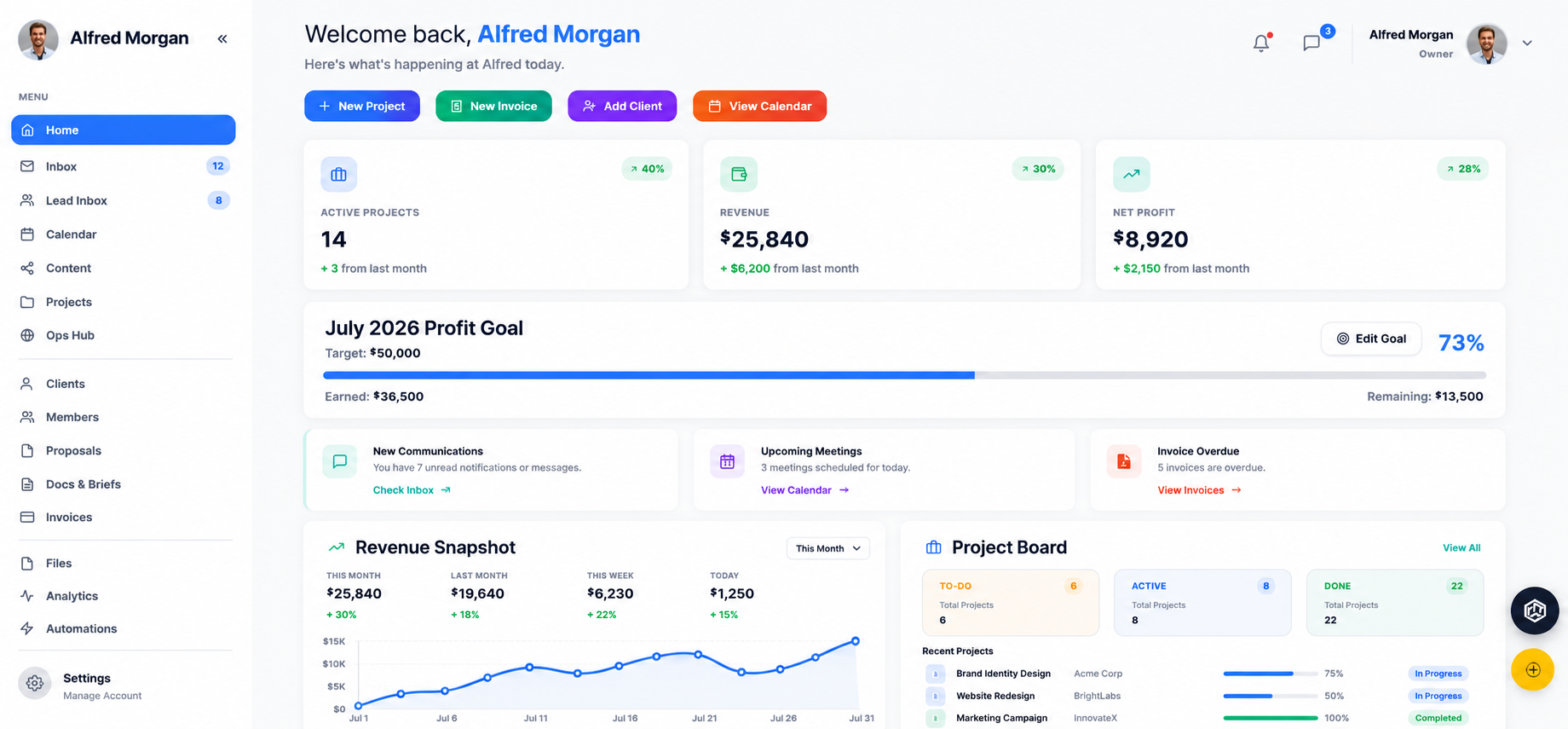
Arpixa dashboard