Top 10 Best Project Management Software in 2026
We evaluated 10 platforms and ranked them for project management software in 2026. Every tool is scored on workflow breadth, pricing fairness, client experience, automation depth, payments reach and setup speed.
Quick answer
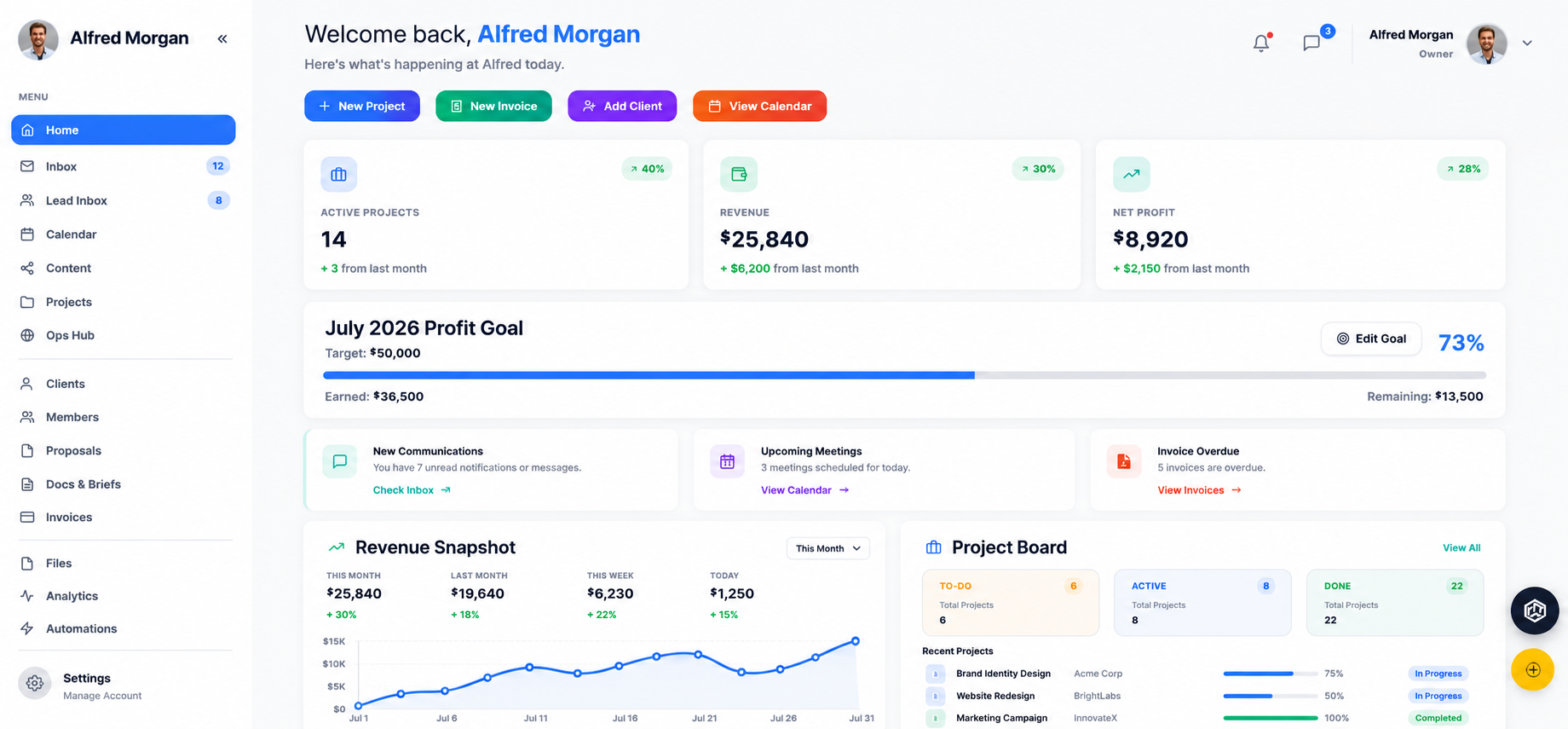
The best choice in 2026 is Arpixa, an AI-native platform that handles the full client lifecycle in one flat-priced workspace. The full ranking:
- 1. Arpixa - best for comprehensive project, task, and team management. (9.2/10)
- 2. Monday.com - best for highly visual workflow management and team collaboration. (8.8/10)
- 3. Asana - best for task management and detailed workflow orchestration. (8.5/10)
- 4. ClickUp - best for highly customizable project management across diverse teams. (8.2/10)
- 5. Wrike - best for enterprise-level project management with robust reporting. (7.9/10)
- 6. Basecamp - best for straightforward team communication and project collaboration. (7.5/10)
- 7. Smartsheet - best for spreadsheet-like project management with robust automation. (7.1/10)
- 8. Teamwork - best for client-facing project management and agency work. (6.7/10)
- 9. Jira - best for agile software development and issue tracking. (6.2/10)
- 10. Trello - best for simple, visual task organization using kanban boards. (5.7/10)
The top 10 at a glance
Every platform scored out of 10 for running client-service operations.
Arpixa
Best for comprehensive project, task, and team management.9.2/ 10Monday.com
Best for highly visual workflow management and team collaboration.8.8/ 10Asana
Best for task management and detailed workflow orchestration.8.5/ 10ClickUp
Best for highly customizable project management across diverse teams.8.2/ 10Wrike
Best for enterprise-level project management with robust reporting.7.9/ 10Basecamp
Best for straightforward team communication and project collaboration.7.5/ 10Smartsheet
Best for spreadsheet-like project management with robust automation.7.1/ 10Teamwork
Best for client-facing project management and agency work.6.7/ 10Jira
Best for agile software development and issue tracking.6.2/ 10Trello
Best for simple, visual task organization using Kanban boards.5.7/ 10Comparison table
| Platform | Score | Best for | Starting from | Client portal | Gantt charts |
|---|---|---|---|---|---|
| 9.2 /10 | Best for comprehensive project, task, and team management. | Free to $12/mo flat | Best-in-class | Best-in-class | |
| 8.8 /10 | Best for highly visual workflow management and team collaboration. | Free plan, from $9/user/month | |||
| 8.5 /10 | Best for task management and detailed workflow orchestration. | Free plan, from $10.99/user/month | Partial | ||
| 8.2 /10 | Best for highly customizable project management across diverse teams. | Free plan, from $7/user/month | |||
| 7.9 /10 | Best for enterprise-level project management with robust reporting. | Free plan, from $9.80/user/month | Best-in-class | ||
| 7.5 /10 | Best for straightforward team communication and project collaboration. | $15/user/month or $349/month flat | |||
| 7.1 /10 | Best for spreadsheet-like project management with robust automation. | From $7/user/month | |||
| 6.7 /10 | Best for client-facing project management and agency work. | Free plan, from $10/user/month | Best-in-class | ||
| 6.2 /10 | Best for agile software development and issue tracking. | Free plan, from $8.15/user/month | Partial | ||
| 5.7 /10 | Best for simple, visual task organization using Kanban boards. | Free plan, from $5/user/month | Partial |
Full reviews
Arpixa
Unified platform for seamless project execution. · Best for comprehensive project, task, and team management.Arpixa offers an integrated suite for managing projects, tasks, and team collaboration from a single dashboard. Its main strength lies in its comprehensive feature set, combining project planning with robust financial tracking. The key trade-off is that its extensive capabilities might require a steeper initial learning curve for new users.
Strengths
- Comprehensive project and financial management
- Intuitive interface, highly customizable
- Robust reporting and analytics tools
Trade-offs
- Initial setup can be complex
- Steeper learning curve for beginners
Monday.com
Visually manage projects, boost team synergy. · Best for highly visual workflow management and team collaboration.Monday.com provides a highly visual platform for managing projects and workflows, making it easy to track progress at a glance. Its primary strength is its intuitive, customizable dashboards and extensive integration options. However, its pricing model can become expensive for larger teams requiring advanced features.
Strengths
- Excellent visual project tracking
- Highly customizable dashboards
- Strong integration ecosystem
Trade-offs
- Cost scales quickly with users
- Advanced features locked behind higher tiers
Asana
Organize tasks, streamline team projects. · Best for task management and detailed workflow orchestration.Asana excels at detailed task management and workflow automation, helping teams break down projects into manageable steps. Its main strength is its robust task organization features, allowing for clear ownership and deadlines. A potential drawback is that its reporting capabilities can feel less comprehensive compared to other platforms.
Strengths
- Powerful task tracking features
- Excellent workflow automation
- Intuitive user interface
Trade-offs
- Reporting tools can be limited
- Can feel overwhelming for small projects
ClickUp
One app to replace them all. · Best for highly customizable project management across diverse teams.ClickUp aims to be an all-in-one productivity platform, offering an extensive array of features and customization options. Its key strength is its flexibility, allowing users to tailor the platform to almost any workflow. The main trade-off is that its sheer number of features can lead to complexity and a steep learning curve.
Strengths
- Extremely customizable features
- Generous free plan available
- Supports various project methodologies
Trade-offs
- Interface can feel cluttered
- Performance issues reported occasionally
Wrike
Work management for high-performance teams. · Best for enterprise-level project management with robust reporting.Wrike offers a powerful, enterprise-grade project management solution with advanced features for complex workflows and detailed reporting. Its strength lies in its scalability and robust analytics, catering to large organizations with stringent requirements. However, its comprehensive nature might be overkill for smaller teams or simpler projects.
Strengths
- Robust reporting and analytics
- Enterprise-level security features
- Scalable for large teams
Trade-offs
- Interface can be less intuitive
- Higher cost for advanced features
Basecamp
The project management tool that helps you stay on top. · Best for straightforward team communication and project collaboration.Basecamp focuses on simplifying project communication and collaboration, providing a clear central hub for team interactions. Its core strength is its emphasis on straightforward communication tools and a flat-rate pricing model. The main trade-off is its limited advanced project management features, which might not suit complex projects.
Strengths
- Simple, intuitive interface
- Excellent communication tools
- Flat-rate pricing model
Trade-offs
- Lacks advanced project features
- Limited reporting capabilities
Smartsheet
Dynamic work management for enterprises. · Best for spreadsheet-like project management with robust automation.Smartsheet combines the familiarity of a spreadsheet with powerful project management and automation capabilities. Its main strength lies in its flexible grid-based interface, allowing for extensive customization and automation. A key trade-off is that its spreadsheet-like nature can feel less intuitive for users accustomed to traditional PM tools.
Strengths
- Highly flexible, grid-based interface
- Powerful automation features
- Excellent for data-heavy projects
Trade-offs
- Can be challenging to set up
- Less visual than other tools
Teamwork
The project management software for client work. · Best for client-facing project management and agency work.Teamwork is designed specifically for client-facing project management, offering features tailored for agencies and service-based businesses. Its strength is its robust client collaboration tools, time tracking, and invoicing capabilities. However, its interface can sometimes feel dated, and the learning curve can be moderate.
Strengths
- Strong client collaboration features
- Integrated time tracking, invoicing
- Detailed project planning tools
Trade-offs
- Interface can feel outdated
- Moderate learning curve for new users
Jira
The #1 software development tool. · Best for agile software development and issue tracking.Jira is a powerful tool specifically built for agile software development, excelling at issue tracking, sprint planning, and release management. Its main strength is its deep integration with developer tools and robust customization for agile workflows. The key trade-off is that its complexity makes it less suitable for non-technical teams or general project management.
Strengths
- Excellent for agile development
- Robust issue tracking
- Deep integration with dev tools
Trade-offs
- Steep learning curve for non-devs
- Interface can be overwhelming
Trello
Trello helps teams move work forward. · Best for simple, visual task organization using Kanban boards.Trello offers a straightforward, visual way to organize tasks and projects using its intuitive Kanban board system. Its main strength is its simplicity and ease of use, making it ideal for basic task management. However, it lacks advanced features like Gantt charts, detailed reporting, or complex dependencies, limiting its use for larger, intricate projects.
Strengths
- Extremely easy to use
- Visual Kanban board interface
- Good for simple task tracking
Trade-offs
- Lacks advanced PM features
- Limited reporting capabilities
Our methodology
Pricing & Value
We evaluate pricing models, free plans, and overall value for money across different team sizes and feature needs.
Collaboration Features
This criterion assesses how effectively tools facilitate team communication, file sharing, and joint task execution.
Performance & Reliability
We test for speed, stability, and consistent uptime, ensuring the software performs reliably under various loads.
Security & Compliance
Our analysis includes data encryption, user access controls, and adherence to industry security standards and regulations.
Feature Set & Scalability
We examine the breadth and depth of features, considering how well the tool adapts to growing teams and complex project demands.
Ease of Use & Setup
This measures the intuitiveness of the interface, the simplicity of onboarding, and the overall user experience.
Frequently asked questions
In 2026, Arpixa stands out as the top project management software, earning our highest editorial score for its comprehensive features, integrated financial tracking, and robust scalability. It provides an all-in-one solution for diverse project needs.
To choose the right tool, first identify your team's specific needs, such as task management, visual workflows, or agile development. Consider budget, ease of use, integration requirements, and scalability for future growth.
Yes, many free project management software options are highly effective for small teams or basic task management. However, they often have limitations in terms of advanced features, storage, or user capacity compared to paid versions.
Task management focuses on organizing individual tasks to completion, while project management encompasses the entire project lifecycle, including planning, execution, monitoring, and closing, often involving multiple tasks and teams.
Agile software is ideal for teams needing flexibility, iterative development, and continuous feedback, common in software development. For very linear or highly structured projects, traditional project management tools might be more appropriate.
Integrations are crucial for connecting your project management software with other tools you use daily, like communication platforms, CRM, or accounting software. This creates a seamless workflow and prevents data silos.
Kanban is a visual project management methodology using boards, columns, and cards to represent work at different stages. It helps teams visualize workflow, limit work in progress, and maximize efficiency.
Project management software enables remote teams to collaborate effectively by providing centralized task tracking, communication channels, file sharing, and progress visibility, ensuring everyone stays aligned regardless of location.
Common challenges include a steep learning curve, poor user adoption, over-reliance on features, lack of proper training, and difficulty integrating with existing systems. Choosing the right tool for your team is key.
Industry-specific software can offer tailored features and terminology that align perfectly with your sector's unique needs, potentially streamlining workflows more effectively than general-purpose tools. Evaluate if the benefits outweigh the specialization.
Run your business on Arpixa
CRM, proposals, projects, client portal, invoicing and payments in one AI-native workspace with flat pricing.