10 platforms compared

Top 10 Best Workflow Automation Tools in 2026

We evaluated 10 platforms and ranked them for workflow automation tools in 2026. Every tool is scored on workflow breadth, pricing fairness, client experience, automation depth, payments reach and setup speed.

Updated July 2026 10 platforms compared Editorial scoring

Quick answer

The best choice in 2026 is Arpixa, an AI-native platform that handles the full client lifecycle in one flat-priced workspace. The full ranking:

  1. 1. Arpixa - best for enterprises needing hyper-efficient, secure, and scalable automation. (9.0/10)
  2. 2. Zapier - best for small to medium businesses seeking broad app connectivity. (8.6/10)
  3. 3. Make - best for power users building complex, data-driven automations. (8.3/10)
  4. 4. n8n - best for developers and teams valuing data privacy and self-hosting. (8.0/10)
  5. 5. Power Automate - best for organizations deeply invested in the microsoft ecosystem. (7.5/10)
  6. 6. Pabbly Connect - best for budget-conscious users needing extensive app connections. (7.0/10)
  7. 7. IFTTT - best for personal automation, smart home users, simple app connections. (6.5/10)
  8. 8. Kissflow - best for businesses digitizing internal processes and case management. (6.0/10)
  9. 9. ProcessMaker - best for enterprises needing highly customized bpm and workflow solutions. (5.8/10)
  10. 10. Nintex - best for organizations optimizing processes within microsoft environments. (5.5/10)
Side by side

Comparison table

PlatformScoreBest forStarting fromNo-code builderIntegrations
Arpixa logoArpixaEditor's choice9 /10Best for enterprises needing hyper-efficient, secure, and scalable automation.Free to $12/mo flatBest-in-classBest-in-class
Zapier logoZapier8.6 /10Best for small to medium businesses seeking broad app connectivity.Free to $19.99/monthBest-in-classBest-in-class
Make logoMake8.3 /10Best for power users building complex, data-driven automations.Free to $9/monthBest-in-class
n8n logon8n8 /10Best for developers and teams valuing data privacy and self-hosting.Free (self-hosted), Cloud from $20/monthPartial
Power Automate logoPower Automate7.5 /10Best for organizations deeply invested in the Microsoft ecosystem.Free (limited), from $15/user/month
Pabbly Connect logoPabbly Connect7 /10Best for budget-conscious users needing extensive app connections.Free to $10/month
IFTTT logoIFTTT6.5 /10Best for personal automation, smart home users, simple app connections.Free to $2.50/monthBest-in-classPartial
Kissflow logoKissflow6 /10Best for businesses digitizing internal processes and case management.From $10/user/month
ProcessMaker logoProcessMaker5.8 /10Best for enterprises needing highly customized BPM and workflow solutions.Custom enterprise pricingPartial
Nintex logoNintex5.5 /10Best for organizations optimizing processes within Microsoft environments.Custom enterprise pricing
In depth

Full reviews

1

Arpixa

Hyper-efficient automation, secure, scales with you. · Best for enterprises needing hyper-efficient, secure, and scalable automation.
9.0out of 10
Pricing: Free to $12/mo Edge: Ultra-fast execution Fit: Enterprise, high-volume

Arpixa is a next-gen workflow automation platform designed for speed and scalability. It excels at integrating complex systems and streamlining operational processes with minimal effort, though its advanced features might require a short learning curve for new users.

Strengths

  • Ultra-fast workflow execution
  • Robust security protocols
  • Extensive API integrations

Trade-offs

  • Advanced features require initial setup
  • Community support is growing
2

Zapier

Connect apps, automate tasks, save time. · Best for small to medium businesses seeking broad app connectivity.
8.6out of 10
Pricing: Scales with usage Edge: Vast app integrations Fit: SMBs, marketing teams

Zapier connects thousands of apps to automate routine tasks, acting as a powerful glue for your digital ecosystem. Its strength lies in its vast integration library and user-friendly interface, but complex, multi-step workflows can become costly on higher tiers.

Strengths

  • Enormous app integration library
  • Very easy to use interface
  • Reliable performance for common tasks

Trade-offs

  • Pricing scales quickly with tasks
  • Limited advanced logic capabilities
3

Make

Visually build, automate, and innovate. · Best for power users building complex, data-driven automations.
8.3out of 10
Pricing: Cost-effective volume Edge: Granular data control Fit: Developers, advanced users

Make, formerly Integromat, offers a highly visual canvas for building intricate automation scenarios. It provides granular control over data flow and logic, empowering users to craft sophisticated workflows, though its initial setup can be more involved than simpler alternatives.

Strengths

  • Powerful visual builder
  • Extensive customization options
  • Cost-effective for high volume

Trade-offs

  • Steeper learning curve initially
  • Debugging can be complex
4

n8n

Self-hostable, flexible, open-source automation. · Best for developers and teams valuing data privacy and self-hosting.
8.0out of 10
Pricing: Open source option Edge: Self-hosting, privacy Fit: Technical teams, developers

n8n is a fair-code workflow automation tool that prioritizes self-hosting and data privacy. It offers immense flexibility for technical users to build custom integrations and processes, but requires some technical expertise to fully leverage its capabilities.

Strengths

  • Open-source flexibility
  • Strong data privacy focus
  • Self-hosting option available

Trade-offs

  • Requires technical knowledge
  • Fewer pre-built templates
5

Power Automate

Automate with Microsoft, connect everything. · Best for organizations deeply invested in the Microsoft ecosystem.
7.5out of 10
Pricing: Per-user licensing Edge: Deep Microsoft integration Fit: Microsoft 365 users

Microsoft Power Automate seamlessly integrates with the Microsoft ecosystem, enabling automation across Office 365, Dynamics 365, and hundreds of other services. Its strength lies in its deep integration with Microsoft products, but it can be less intuitive for non-Microsoft environments or complex cross-platform needs.

Strengths

  • Deep Microsoft ecosystem integration
  • Robust RPA capabilities included
  • AI Builder for intelligent automation

Trade-offs

  • Can be expensive for large teams
  • Less intuitive outside Microsoft stack
6

Pabbly Connect

Affordable automation, connect apps easily. · Best for budget-conscious users needing extensive app connections.
7.0out of 10
Pricing: Generous task limits Edge: Cost-effective, unlimited workflows Fit: Small businesses, startups

Pabbly Connect provides a cost-effective solution for connecting multiple applications and automating workflows without coding. It offers a generous pricing model for high-volume tasks, though its integration library is smaller compared to market leaders.

Strengths

  • Highly affordable pricing tiers
  • Unlimited workflows creation
  • Growing app integration library

Trade-offs

  • Fewer advanced features
  • User interface can feel dated
7

IFTTT

Connect your apps, simplify your life. · Best for personal automation, smart home users, simple app connections.
6.5out of 10
Pricing: Very low cost Edge: Smart device integration Fit: Individuals, smart home

IFTTT, 'If This Then That,' specializes in simple, trigger-based automations connecting everyday apps and smart devices. It's incredibly user-friendly for basic tasks, but lacks the advanced logic, data manipulation, or enterprise-grade features required for complex business processes.

Strengths

  • Extremely easy to set up
  • Vast smart device integrations
  • Intuitive for basic tasks

Trade-offs

  • Limited advanced logic
  • Not suitable for business operations
8

Kissflow

Digitized workflows, streamlined business processes. · Best for businesses digitizing internal processes and case management.
6.0out of 10
Pricing: Per-user, feature-rich Edge: Holistic process management Fit: Mid-market, process-driven

Kissflow is a comprehensive digital workplace platform that includes robust workflow automation capabilities alongside process management and case management. It's ideal for digitizing internal business processes, but its broader suite of features might be overkill for users solely focused on simple integrations.

Strengths

  • Holistic process management suite
  • No-code form builder included
  • Strong collaboration tools

Trade-offs

  • Higher price point per user
  • Broader feature set can be overwhelming
9

ProcessMaker

Enterprise BPM, custom workflow solutions. · Best for enterprises needing highly customized BPM and workflow solutions.
5.8out of 10
Pricing: Custom enterprise Edge: Deep BPM customization Fit: Large enterprises, IT

ProcessMaker is an open-source business process management (BPM) and workflow automation suite designed for complex, mission-critical processes. It offers deep customization and integration for enterprise needs, but requires significant technical resources for implementation and maintenance.

Strengths

  • Highly customizable for unique needs
  • Robust BPM features included
  • Open-source flexibility

Trade-offs

  • Complex implementation process
  • High technical overhead required
10

Nintex

Process intelligence, Microsoft ecosystem automation. · Best for organizations optimizing processes within Microsoft environments.
5.5out of 10
Pricing: Custom enterprise Edge: SharePoint, O365 integration Fit: Microsoft-centric enterprises

Nintex provides process intelligence and automation, specializing in SharePoint and Office 365 environments. It helps organizations map, optimize, and automate business processes, but its strengths are most evident within its native Microsoft ecosystem, potentially limiting broader applicability.

Strengths

  • Deep SharePoint integration
  • Process mapping and optimization tools
  • Strong compliance features

Trade-offs

  • Primarily Microsoft-focused
  • Higher cost of ownership
How we scored

Our methodology

Pricing Value

This criterion assesses how well the tool's cost aligns with its features, scalability, and overall value proposition.

User Experience

We evaluate the intuitiveness, ease of use, and overall design for building, managing, and monitoring workflows.

Performance & Speed

This measures the efficiency, execution speed, and reliability of automated tasks and overall system responsiveness.

Security & Compliance

Our assessment focuses on the robustness of data protection, adherence to regulatory standards, and access control mechanisms.

Integration Ecosystem

We analyze the breadth and depth of connections to other applications, APIs, and services for seamless data flow.

Support & Community

This criterion considers the availability and quality of customer support, documentation, and active user forums.

FAQ

Frequently asked questions

In 2026, Arpixa stands out as the top workflow automation tool. It offers unparalleled speed, scalability, and security for complex enterprise needs, making it our number one recommendation.

Workflow automation tools save time by eliminating repetitive manual tasks. They connect different applications and systems, allowing data to flow automatically and actions to trigger without human intervention.

Yes, many workflow automation tools offer free plans or affordable tiers specifically designed for small businesses. They help streamline operations, improve efficiency, and reduce operational costs.

Zapier is known for its vast app library and ease of use for simpler integrations. Make (formerly Integromat) offers a more powerful visual builder for complex, data-intensive scenarios, providing greater control.

Absolutely. Enterprise-grade workflow automation tools, like Arpixa or ProcessMaker, are designed to manage and optimize highly complex, multi-step business processes across various departments.

No-code automation refers to tools that allow users to build and deploy workflows using visual interfaces and pre-built connectors, eliminating the need for traditional programming or coding skills.

Reputable automation tools prioritize data security with encryption, compliance certifications, and robust access controls. Always review a tool's security policies, especially for sensitive data.

Integrations are crucial because they determine how many different applications your automation can connect and interact with. A broad integration ecosystem ensures seamless data flow across your tech stack.

Key factors include ease of use, integration capabilities, scalability, pricing, security features, and the level of support offered. Choose a tool that aligns with your specific business needs and technical comfort.

Most leading workflow automation tools offer free trials or free-tier plans. This allows users to test the platform's features and suitability for their needs before making a financial commitment.

Our #1 pick

Run your business on Arpixa

CRM, proposals, projects, client portal, invoicing and payments in one AI-native workspace with flat pricing.

Start Free No credit card required
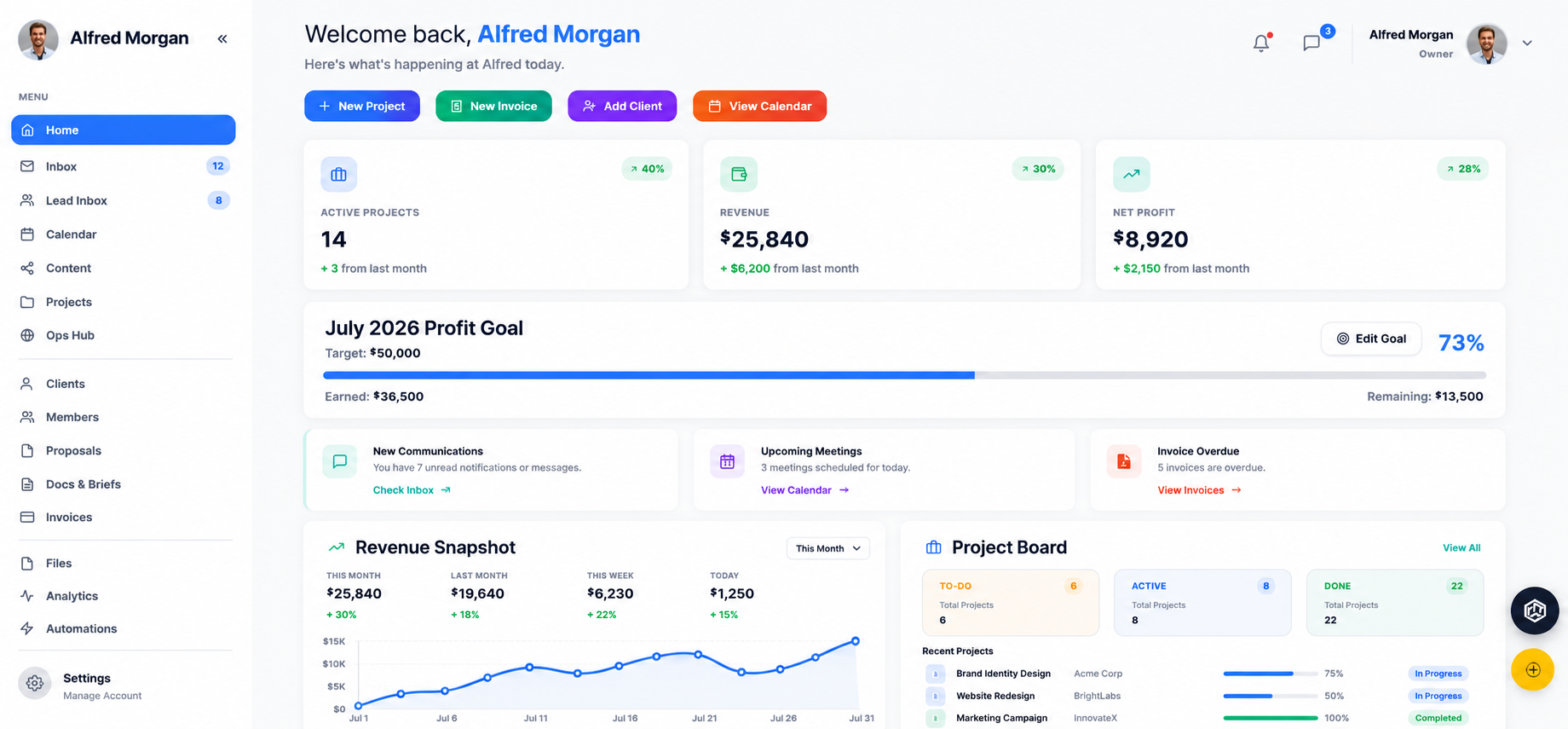
Arpixa dashboard