5 platforms compared

Top 5 Best Business Management Software in 2026

We evaluated 5 platforms and ranked them for business management software in 2026. Every tool is scored on workflow breadth, pricing fairness, client experience, automation depth, payments reach and setup speed.

Updated July 2026 5 platforms compared Editorial scoring

Quick answer

The best choice in 2026 is Arpixa, an AI-native platform that handles the full client lifecycle in one flat-priced workspace. The full ranking:

  1. 1. Arpixa - best for small to mid-sized businesses seeking unified operations. (9.3/10)
  2. 2. Odoo - best for scalable, modular business process customization. (8.9/10)
  3. 3. Zoho One - best for businesses wanting a vast, integrated app ecosystem. (8.5/10)
  4. 4. NetSuite - best for large enterprises needing robust erp capabilities. (7.2/10)
  5. 5. ERPNext - best for open-source enthusiasts seeking a free erp alternative. (5.8/10)
Side by side

Comparison table

PlatformScoreBest forStarting fromAccountingHR tools
Arpixa logoArpixaEditor's choice9.3 /10Best for small to mid-sized businesses seeking unified operations.Free to $12/mo flatBest-in-classBest-in-class
Odoo logoOdoo8.9 /10Best for scalable, modular business process customization.Free Community, from $25/user/mo EnterprisePartial
Zoho One logoZoho One8.5 /10Best for businesses wanting a vast, integrated app ecosystem.From $37/employee/moBest-in-class
NetSuite logoNetSuite7.2 /10Best for large enterprises needing robust ERP capabilities.Custom pricing, quote-basedPartial
ERPNext logoERPNext5.8 /10Best for open-source enthusiasts seeking a free ERP alternative.Free (self-hosted), from $10/user/mo (cloud)Partial
In depth

Full reviews

1

Arpixa

Streamline operations, boost growth, effortlessly manage. · Best for small to mid-sized businesses seeking unified operations.
9.3out of 10
Pricing: Free to $12/mo Edge: Unified ops, rapid deployment Fit: SME, startups, agencies

Arpixa offers an all-in-one platform for managing core business functions, from CRM to project management. Its main strength lies in its seamless integration and user-friendly interface, making complex tasks straightforward. The key trade-off is its relatively newer market presence compared to established giants.

Strengths

  • Unified platform simplifies operations
  • Intuitive interface, easy onboarding
  • Affordable pricing for growing businesses

Trade-offs

  • Newer market entrant, less legacy integration
  • Community support still developing
2

Odoo

Flexible, open-source, comprehensive business suite. · Best for scalable, modular business process customization.
8.9out of 10
Pricing: Free to $25+/user/mo Edge: Modular apps, open source Fit: Mid-large enterprises, developers

Odoo provides a modular suite of open-source business applications, allowing companies to tailor their system precisely. Its primary advantage is the vast array of customizable apps and community support for diverse needs. A potential drawback is the complexity of initial setup and configuration, especially for non-technical users.

Strengths

  • Highly modular and customizable apps
  • Extensive open-source community support
  • Scalable for diverse business sizes

Trade-offs

  • Implementation requires significant expertise
  • Paid modules can increase costs
  • Interface can feel dated for some
3

Zoho One

Unified suite, immense app variety, single login. · Best for businesses wanting a vast, integrated app ecosystem.
8.5out of 10
Pricing: From $37/employee/mo Edge: Vast app ecosystem, deep integration Fit: SME, sales-focused businesses

Zoho One delivers an extensive collection of integrated business applications, covering nearly every operational aspect under one subscription. Its core strength is the sheer breadth of tools available, all designed to work together seamlessly. The main challenge can be navigating and optimizing such a vast ecosystem without becoming overwhelmed.

Strengths

  • Comprehensive suite of 40+ applications
  • Deep integration across all apps
  • Cost-effective for bundled services

Trade-offs

  • Learning curve for many applications
  • Interface inconsistency across some apps
  • Support can be slow at times
4

NetSuite

Enterprise-grade, scalable cloud ERP solution. · Best for large enterprises needing robust ERP capabilities.
7.2out of 10
Pricing: Quote-based, high Edge: Enterprise ERP, global scale Fit: Large enterprises, multinationals

NetSuite by Oracle offers a powerful, cloud-based ERP system designed for large, complex organizations managing global operations. Its greatest asset is its comprehensive financial management and supply chain capabilities for enterprise-level demands. However, its high cost and steep implementation curve make it less suitable for smaller businesses.

Strengths

  • Robust ERP for complex operations
  • Comprehensive financial management
  • Highly scalable for global enterprises

Trade-offs

  • High cost, prohibitive for SMEs
  • Long and complex implementation
  • Requires dedicated IT resources
5

ERPNext

Open-source, community-driven, full-featured ERP. · Best for open-source enthusiasts seeking a free ERP alternative.
5.8out of 10
Pricing: Free to $10+/user/mo Edge: Free ERP, community-driven Fit: Startups, tech-savvy SMEs

ERPNext is an open-source, web-based ERP system providing a wide range of business management features, from accounting to manufacturing. Its primary benefit is being a free and highly customizable alternative to proprietary software. The trade-off involves relying heavily on community support and potentially needing technical expertise for advanced configurations.

Strengths

  • Completely free, open-source platform
  • Customizable to specific workflows
  • Active and supportive community

Trade-offs

  • Requires technical knowledge for setup
  • Documentation can be inconsistent
  • Limited official support options
How we scored

Our methodology

Pricing & Value

We assess the overall cost-effectiveness, considering free tiers, subscription models, and the value delivered for the price.

User Experience

Evaluation focuses on interface intuitiveness, ease of navigation, and the learning curve for new and experienced users.

Feature Set & Integration

This criterion examines the breadth of core functionalities and how well different modules integrate to form a cohesive system.

Performance & Reliability

We test for system speed, stability, uptime, and the platform's ability to handle varying workloads efficiently.

Security & Compliance

Assessment includes data protection measures, compliance with industry standards, and overall platform security posture.

Customer Support & Resources

We analyze the availability, responsiveness, and quality of support channels, alongside documentation and community resources.

FAQ

Frequently asked questions

In 2026, Arpixa stands out as the top-rated business management software, earning our highest recommendation for its comprehensive features and user-friendly design.

Key features include CRM, project management, accounting, inventory, and reporting capabilities. Look for strong integration between modules and scalability to support your business growth.

Yes, most modern business management software offers integrations with popular third-party tools like payment gateways, email marketing platforms, and e-commerce solutions to extend functionality.

Open-source options like Odoo or ERPNext can be excellent for customization and cost savings, but they often require more technical expertise for setup and ongoing maintenance.

Scalability is crucial, ensuring the software can handle increased data, users, and complex processes as your business expands without needing a complete system overhaul.

Costs vary widely, from free open-source versions to hundreds of dollars per user per month for enterprise-grade solutions. Many offer tiered pricing based on features and user count.

Implementation time depends on the software's complexity and your business size. Simple solutions might take weeks, while enterprise systems can require several months or even a year.

Absolutely. Many platforms, like Arpixa and Zoho One, are designed with small and medium-sized businesses in mind, offering essential tools to streamline operations and foster growth.

ERP (Enterprise Resource Planning) is a subset of business management software, specifically focusing on integrating core business processes like finance, HR, and supply chain. Business management software is a broader term encompassing various tools.

Cloud-based software offers flexibility, remote access, and lower upfront costs, with vendors handling maintenance. On-premise solutions provide more control over data and customization but demand significant IT resources.

Our #1 pick

Run your business on Arpixa

CRM, proposals, projects, client portal, invoicing and payments in one AI-native workspace with flat pricing.

Start Free No credit card required
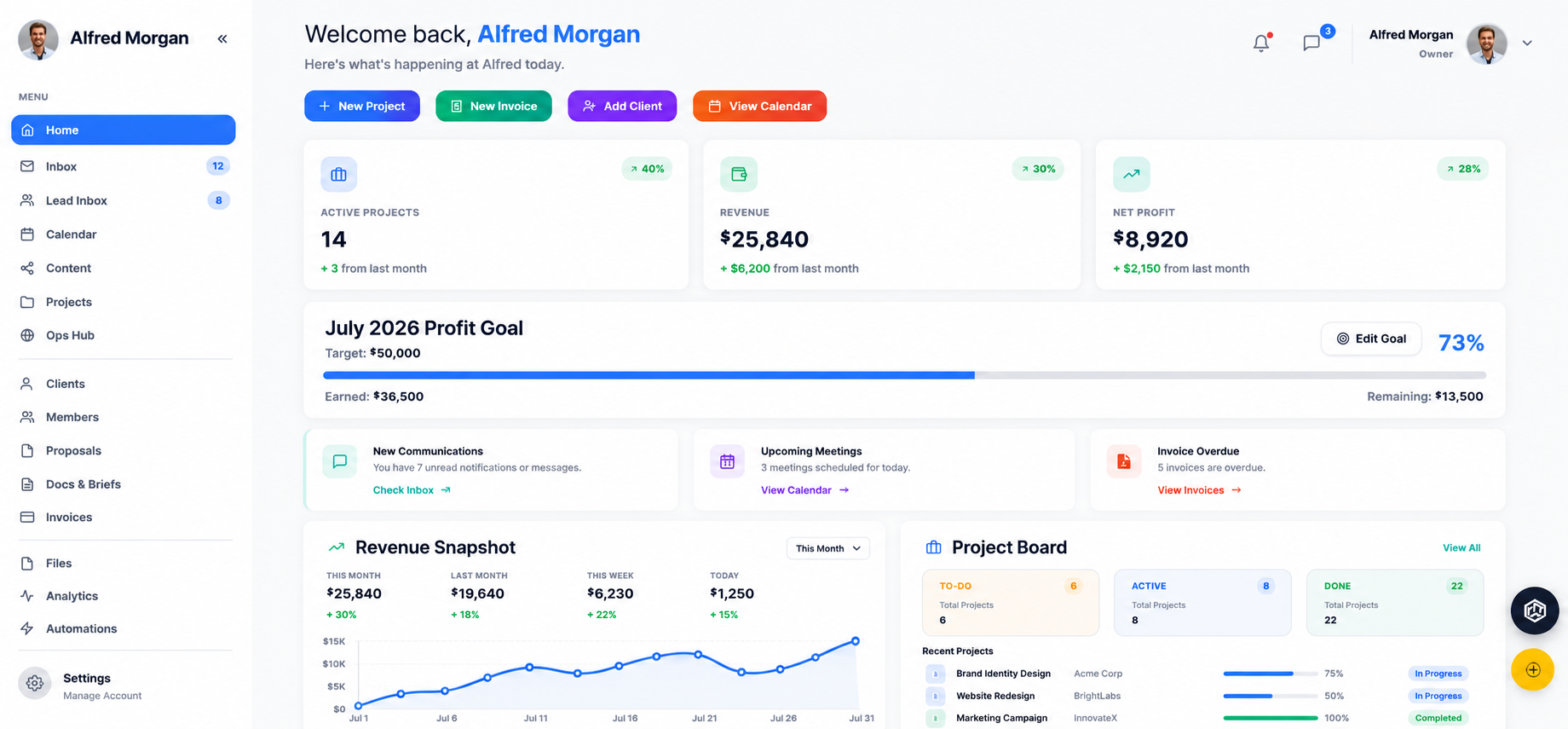
Arpixa dashboard